
Unlocking New Fixed-Target Possibilities at the LHC with TWOCRYST
By Pascal Hermes on behalf of the TWOCRYST Collaboration
A new way to access rare physics at the LHC
Exploring subtle properties of fundamental particles often requires innovative ways to exploit particle accelerators. ALADDIN (An LHC Apparatus for Direct Dipole moments INvestigation) is a newly proposed fixed-target experiment at the LHC that aims to perform the first direct measurements of the electric and magnetic dipole moments of charm baryons. These observables are exquisitely sensitive to physics beyond the Standard Model and offer a new window onto CP violation and the internal structure of matter.
At first glance, the challenge appears unsolvable: charm baryons live for only a few hundred femtoseconds. Even at momenta of roughly 1 TeV/𝑐 they travel only a few centimetres before decaying. To measure their dipole moments, their spins must be manipulated within this extremely short time. ALADDIN addresses this problem by exploiting a key feature of advanced accelerator technology: bent-crystal channelling. It relies on the intense electromagnetic fields inside a crystal lattice to deflect particles and induce spin precession in such short-lived particles.
This ambitious concept relies on a double-crystal scheme: one crystal extracts a very small, well-controlled fraction of the LHC beam halo and guides them onto a fixed target. A second, downstream crystal channels charm baryons immediately after their production. Before such a technique can be adopted for routine operation, it must be demonstrated experimentally under realistic machine conditions. This is precisely the role of TWOCRYST.
The first double-crystal setup in the LHC
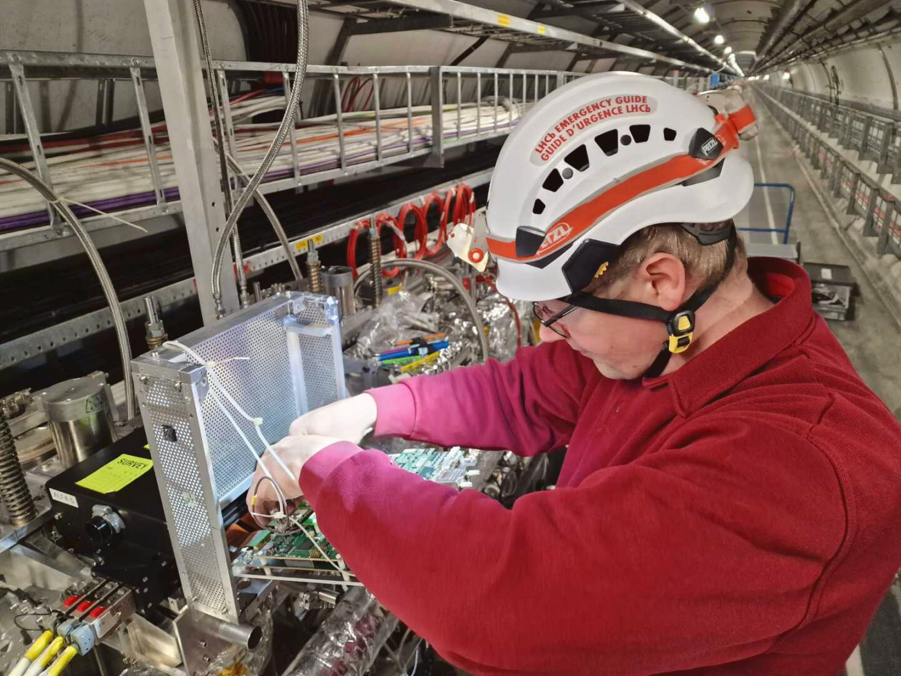
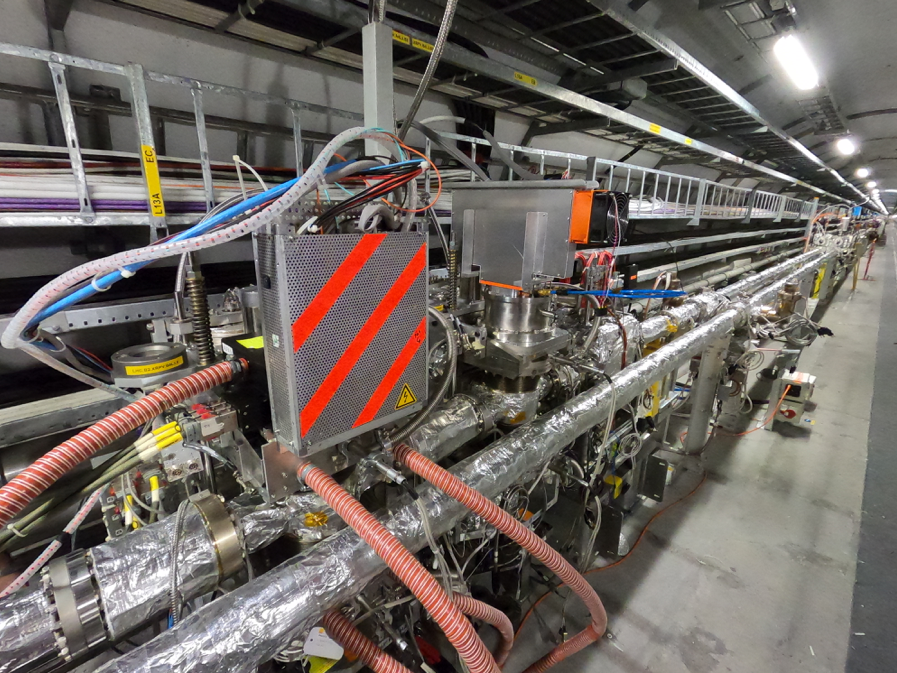
TWOCRYST is a scaled-down, proof-of-principle implementation of this idea. Installed at the LHC in IR3 (see Figure1), it reproduces all critical machine and hardware aspects of the ALADDIN scheme. The project is led by CERN BE-ABP and is carried out under the Physics Beyond Colliders Fixed-Target Working Group. The international collaboration behind TWOCRYST consists of CERN; INFN (Italy); IFIC (University of Valencia–CSIC, Spain); IJCLab (France); the University of Malta; the Institute of Nuclear Physics of the Polish Academy of Sciences; Warsaw University of Technology (Poland); and UCAS (China).
The TWOCRYST experiment addresses three key challenges:
- – Measuring the channelling efficiency of a centimetre-long precession crystal representative of the device required for a charm-baryon experiment.
- – Achieving microradian-level angular alignment between two bent crystals and the LHC beam: a prerequisite for efficient double channelling.
- – Demonstrating operationally the integration of crystal devices into the LHC collimation system to provide a controlled proton flux onto the target, while maintaining safe retraction from the circulating beam.
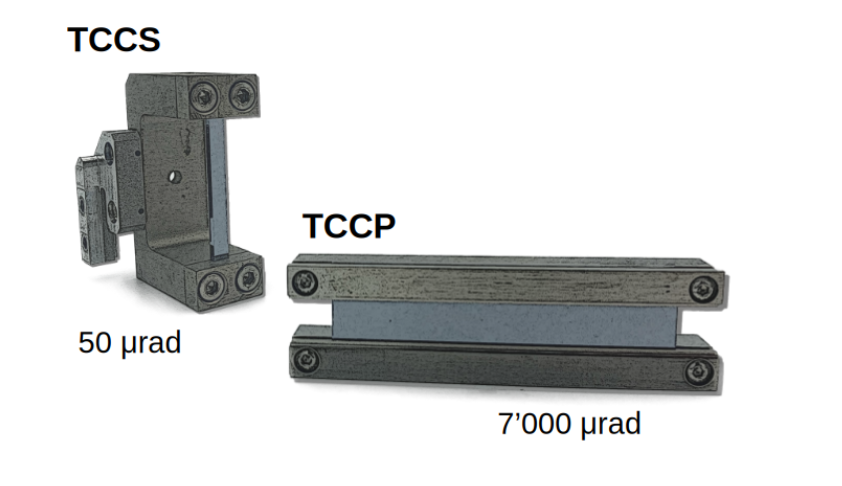
The experimental setup includes a short 4 mm splitting crystal (TCCS) providing a 50 µrad deflection, a fixed tungsten target of 5mm length, and a long precession crystal (TCCP) with a length of 7 cm and a bending angle of 7 mrad. This is the longest and heaviest crystal ever installed in the LHC. Both crystals are shown in Figure 2.
A dedicated high-precision goniometer was developed for TWOCRYST by CERN SY-STI. It is capable of providing microradian alignment accuracy with the TCCP crystal, while integrating the fixed target, thus enabling studies in the full operational configuration.
The setup is complemented by dedicated high-resolution two-dimensional detectors housed in movable Roman Pots, which measure single- and double-channelled beams downstream of the crystals. The first detector is a silicon pixel detector (based on the LHCb VELO detector), developed, implemented, and operated by CERN’s collaborators. The second detector is a fibre tracker provided to the TWOCRYST experiment by the ATLAS–ALFA Collaboration and operated by CERN EP-DT.
A record-breaking experiment
TWOCRYST has been successfully operated during several Machine Development sessions at the LHC in 2025, marking the first time that a double-crystal channelling setup has been deployed and controlled in the LHC.
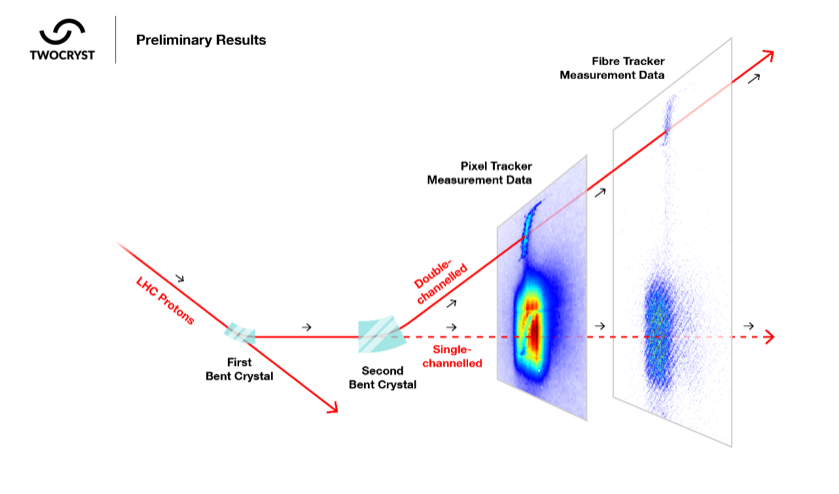
A critical configuration to probe is the double channelling. Halo protons are first channelled by the upstream TCCS crystal and deflected towards the second crystal, where a fraction of these already channelled particles is captured and channelled again. This two-step deflection is directly visible in the experimental data through the appearance of distinct single- and double-channelled beam spots on the downstream detectors, as illustrated in the 450 GeV measurement shown in Figure 3.
The previous energy record for double channelling, 270 GeV, achieved at the CERN SPS, has now been surpassed three times by TWOCRYST, with successful double channelling observed at 450 GeV, 1 TeV, and 2 TeV. This achievement demonstrates that the required simultaneous alignment precision can be achieved. The collected data are currently being analysed to extract the channelling efficiency of the long crystal, a critical parameter for the physics reach of ALADDIN, where charm baryons in this energy range must be channelled. These experimental results are being carefully compared with simulations to establish a quantitative performance baseline.
Another dedicated set of measurements addressed a key operational question: how many particles can be delivered to a fixed target when the short crystal is embedded in the LHC collimation hierarchy. The transmission of halo protons, from the primary collimator in IR7 to the TWOCRYST TCCS crystal in IR3, over a distance of more than 13 km, was measured with the crystal retracted by several beam sizes to reproduce the safety-driven operational scenario foreseen for ALADDIN.
A clear channelling signature was observed, demonstrating that such halo particles can be captured and channelled efficiently. This result validates the feasibility of controlled beam-halo transport onto a fixed target within the stringent constraints of the LHC collimation system.
“TWOCRYST has demonstrated very impressively how bent-crystal techniques can unlock new fixed-target physics opportunities at the LHC and other hadron accelerators,”
Pascal Hermes (BE-ABP), TWOCRYST study leader
Paving the way for ALADDIN and beyond
TWOCRYST represents a major milestone in the development of crystal-assisted beam manipulation at the LHC. It demonstrates that a double-crystal setup can be implemented, precisely aligned, and safely operated in the real accelerator environment, laying the accelerator-physics foundations for ALADDIN and other possible future fixed-target experiments.
As data analysis progresses, TWOCRYST will deliver quantitative benchmarks on efficiency, operational performance, and background levels, directly feeding into the forthcoming Technical Proposal for ALADDIN.
With TWOCRYST, the controlled use of crystals emerges as a mature tool for future fixed-target experiments, extending the established role of bent crystals beyond collimation into new physics applications.