Training the eyes of an accelerator: CAS Beam Instrumentation Course in Split
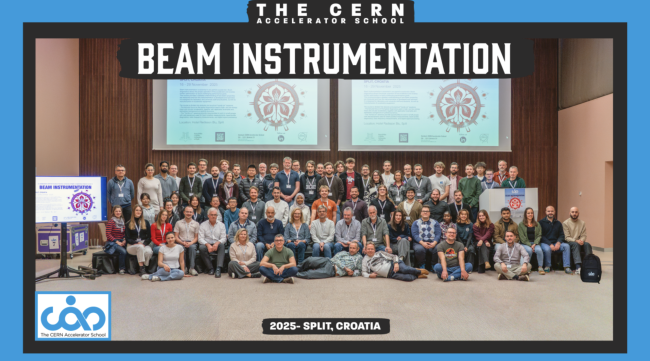
The head of the Beam Instrumentation Group, Thibaut Lefevre, and a member of the program committee for this course, came as a lecturer and hands-on expert. Ironically, Thibaut never attended a CAS course as a student. His first contact with CAS came in 2007, when, after years working at CERN, he was invited by then group leader Hermann Schmickler to develop a lecture on short electron bunch diagnostics for the afternoon courses. Since then, he has been a regular CAS lecturer in beam instrumentation and, for the 2025 edition in Split, he returned, coordinating with CAS and the program committee the design of a course with a curriculum rooted in fundamentals and aligned with the most recent challenges in the field.
Beam instrumentation is sometimes described as the “eyes or the ears” of an accelerator: without it, operators are effectively blind. The Split programme reflects that central role, starting with measurement principles, time‑ and frequency‑domain signal analysis, and transverse and longitudinal beam dynamics, before moving on to detection techniques, timing and synchronisation, and machine protection. For Thibaut, this balance between foundations and frontier topics is deliberate. As Isaac Newton said, we, scientists, are “standing on the shoulders of Giants”, previous generations of physicists and engineers, and CAS has a responsibility to keep that lineage visible while exposing students to today’s state‑of‑the‑art. That is why the course mixes concept‑driven lectures with machine‑specific sessions on diagnostics for hadron synchrotrons and colliders, lepton linacs, FELs and future projects such as FCC‑ee.