
Testing FCC-ee Reverse Phase Operation in the SPS: compensation of a cavity trip
by Lina Valle and Ivan Karpov (SY-RF) on behalf of the FCC-ee RF team.
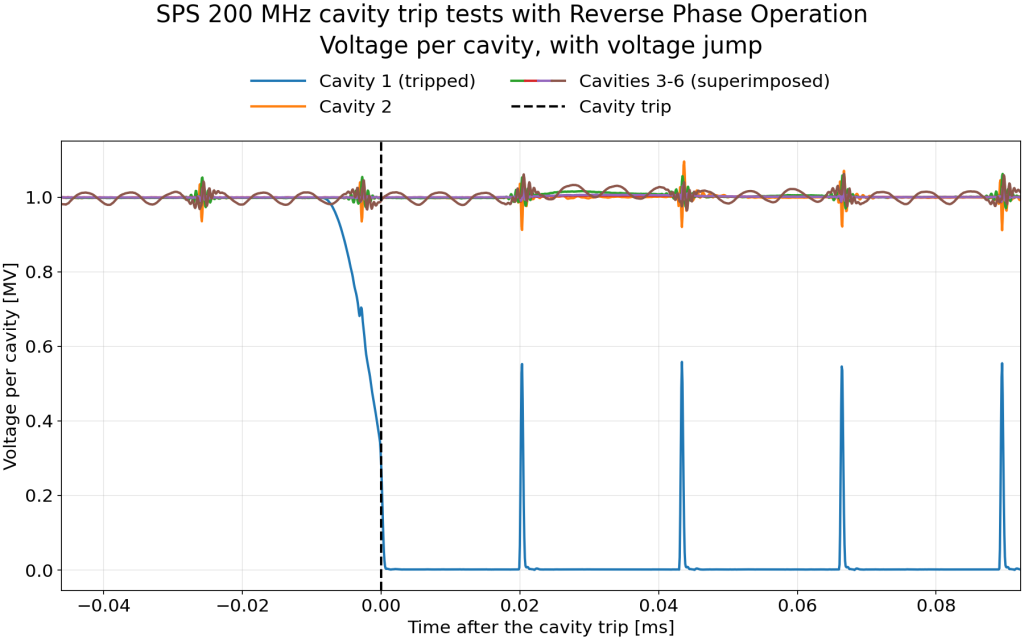
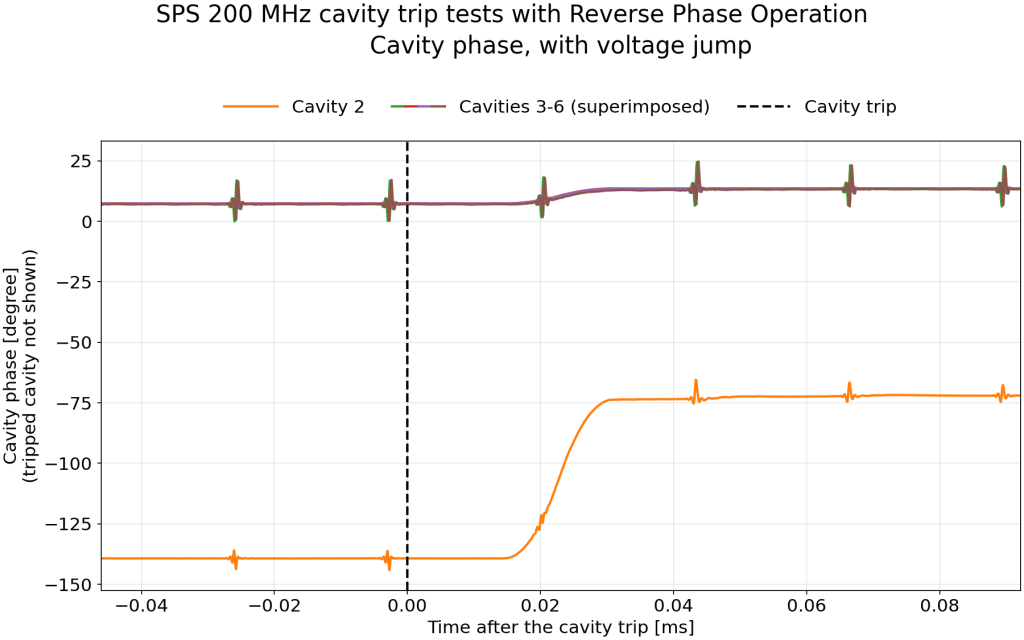
During the very last weeks of the Super Proton Synchrotron (SPS) operation, the 200 MHz travelling-wave cavities were used to test the Reverse Phase Operation (RPO) mode foreseen for the RF system of the Future Circular Collider (FCC) e+e– collider and booster, as well as different compensation methods in case of an RF cavity trip. Like counter-phasing operation, which cancels the voltage of the 200 MHz cavities, the RPO splits the cavities into two families, namely focusing and defocusing, which are dephased with respect to the beam. The sum of their effective voltages defines the operation voltage and the total voltage seen by the beam.
Availability and operability assessments of the FCC-ee collider and its injectors are needed to maximize the physics time and to keep accelerator reliability high. Failure scenarios are being studied and simulated across the project to minimize downtime and implement recovery protocols [1]. A tripped RF cavity is one of the most frequent failures in a synchrotron, and for FCC-ee, it must be compensated within a few turns to maintain beam circulation, as the electrons and positrons will continuously lose energy through synchrotron radiation. Different compensation methods have been simulated in detail since RPO was proposed for the FCC-ee collider and booster [2]. Experimental studies of a tripped cavity in the RPO configuration were previously performed at KEKB [3]. Nonetheless, these tests did not include RF manipulations to recover the total voltage.
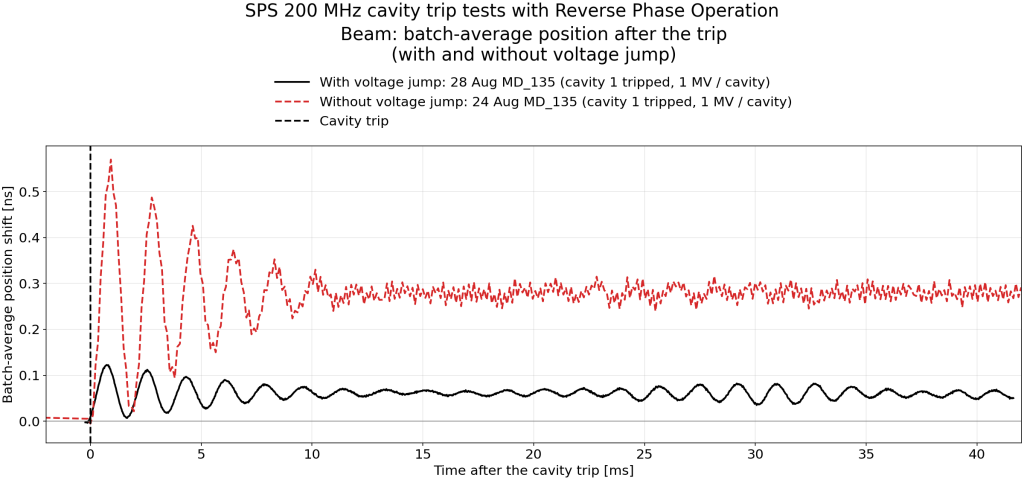
With a batch of 12 bunches at flat bottom and single RF, the 200 MHz voltage and phase programs were set to the RPO configuration. The voltage program of either a focusing or defocusing cavity included a fast drop to trigger an interlock and mimic a cavity trip. Two turns after the trip, the phases of the remaining cavities were changed by the voltage jump to restore the total voltage. The measurement of the voltage and phase of all cavities before and after a focusing cavity trip is displayed in Fig. 1 (top). Thanks to the rephased cavities, the impact of the trip on the beam was strongly reduced, as illustrated in Fig. 1 (bottom), with smaller oscillations of the bunch position after the voltage jump.
Even though the long shutdown has started for the injectors, the FCC-ee RF team is preparing a second round of experiments with protons, including the impact of an energy deficit for the beam. This could include a tripped cavity during acceleration, to imitate the uncompensated energy loss due to synchrotron radiation of an electron or positron beam.
[1] Jack Heron, Buying Physics: Performance–Cost Design Trade-offs for Availability and Integrated Luminosity, FCC Week 2026.
[2] Ivan Karpov, Updates on the Reverse Phase Operation, 196th Accelerator Design Meeting & 67th FCCIS WP2.2 Meeting, Nov. 6th, 2024.
[3] Y. Morita, S. Mitsunobu, T. Furuya, S. Takano, M. Nishiwaki, A. Kabe, K. Akai, “KEKB superconducting accelerating cavities and beam studies for Super-KEKB“, IPAC’10, Kyoto, paper TUPEB011