
New wireless helium sensors for leak detection
By Matthias Vliegen
To identify envelope leaks in large vacuum components, the piece is enclosed in a plastic envelope which is then filled with helium, while the component itself is pumped down and continuously monitored using a leak detector. Due to the size of the components under test, these measurements often need to run for several hours before any helium signal can be detected. Throughout the test, it is essential to maintain a minimum helium concentration around the test object, such as the HL superconducting link (SC Link).
Sensors that report by themselves
Commercial atmospheric helium sensors are large and expensive instruments that provide only local measurements displayed directly on the device. This created the need for a portable, intelligent, compact, and cost-effective sensor that could be deployed at multiple locations along the test setup.
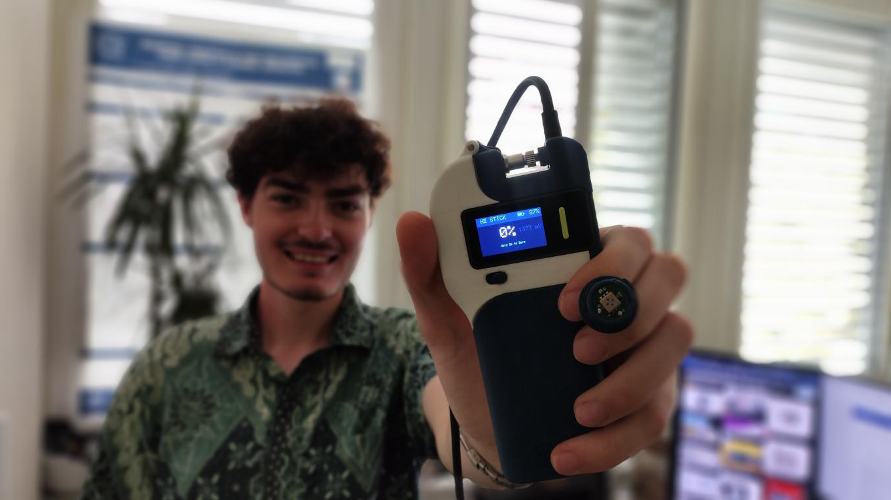
Building on an initial proof of concept, Matthias, a technical student at TE-VSC, developed a highly compact, battery-powered sensor capable of transmitting data wirelessly. Manufactured in-house, each unit costs approximately 100 CHF, making it around 25 times less expensive than commercial alternatives while offering significantly greater functionality.
Multiple sensors can be distributed along the envelope and left in place for the duration of the test, enabling continuous monitoring of helium concentration across the entire test specimen.
To communicate their measurements, the sensors form a Thread mesh network in which each device relays data from its neighboring sensors. In this way, the sensors themselves create the communication path back to a border router connected to a central server. As long as neighboring sensors remain within approximately 20 meters of each other, the network can be extended over much greater distances. During SC Link validation campaigns, several sensors successfully operated together along the 130 meter object.
The sensor itself stays simple, being a microcontroller with a MEMS thermal conductivity element in a 3D printed housing and two replaceable batteries. Thermal conductivity is what works at this size. Helium carries heat around six times better than air, which allows us to measure the helium concentration.
From reading helium to regulating it
Once connected to the network, the sensors do more than simply provide monitoring data. The average helium concentration measured across the sensor network is now used to control PLC-connected valves that inject helium into the envelope as needed. This closed-loop system automatically maintains the required helium concentration throughout the test, replenishing helium periodically when necessary.
A new specific software tool developed in Python (MATREC) monitors the sensors signals and the output of the leak detector.
Together, these new sensors and software tools have proven extremely valuable in ensuring the quality and reliability of leak detection measurements. They also enable rapid identification of any non-conformities that may arise during testing, helping to improve both efficiency and confidence in the validation process.