
New beam dump design for High-Luminosity stored beam energies
By Gabriel Banks (CERN)
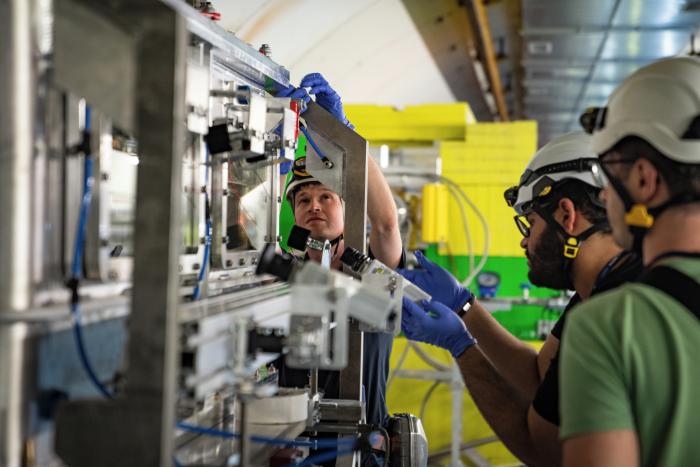
In the LHC beam dumps, the energy stored in the proton beams must be safely absorbed by the core materials. Due to their exceptional thermal shock and radiation resistance, carbon-based materials have been successfully used for this purpose since LHC Run 1. In the High-Luminosity (HL) era, the maximum stored energy in each LHC beam will be approximately 4.5 times greater than in Run 1, placing correspondingly greater demands on the beam dump core materials.
The HRMT65-HLTDE experimentwas performed to validate the performance of both new and previously used carbon-based materials under the increased loads expected for HL operation. Specimens of five grades of isostatic graphite, three grades of carbon fibre reinforced carbon composite, and one grade of flexible graphite sheets were assembled inside the experimental targets, and subjected to a total of almost 500 beam shots from the Super Proton Synchrotron. This equates to a total of over 20 million billion protons!