Major HVAC Upgrade Enhances Safety in the ISOLDE Primary Areas
By Nina Marianna Szczepanik-Scislo
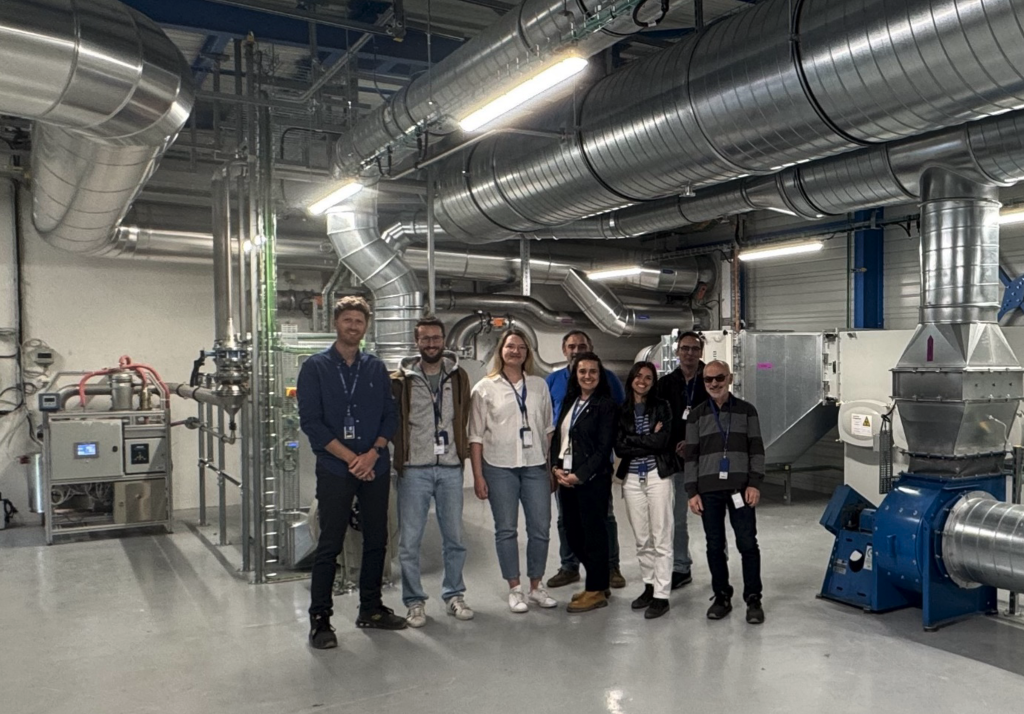
Following a review of fire and radiation safety conducted within the framework of the FIRIA project, an upgrade focused on modernizing HVAC installations serving the ISOLDE primary areas has now been successfully completed.
The previous installation had been in operation for more than 30 years, since ISOLDE was connected to the PS Booster, and did not comply with modern safety norms. The project, led by Melania Averna (SY-STI), began during the YETS 2022–2023 and since has delivered a comprehensive ventilation and filtration solutions designed to meet modern radiation protection and fire safety requirements.
The goal of the project was the installation of a new HVAC system dedicated to the ISOLDE primary areas. To accommodate the new equipment, an additional floor was constructed on top of Building 197. However, to allow this building construction, a large chiller unit and its associated piping was relocated from the roof of Building 197 to the roof of Building 199 in the beginning of 2023.
After the building construction, the CV installations took place in 2025 and 2026. The system now incorporates advanced filtration technologies, including high-efficiency particulate filtration and activated carbon filters designed to capture radioactive volatile species before the discharge to the atmosphere. The new HVAC configuration also provides a complete physical separation between the ventilation systems connected to the primary areas and those serving the building 170 experimental hall, reducing the risk of cross-contamination and improving operational safety.
In addition, the installation includes new fire dampers to limit the propagation of smoke and fire through ventilation ducts for the primary areas, further increasing the ISOLDE fire protection measures. A new 10-metre extraction stack has also been installed on top of Building 197, allowing better dispersion of atmospheric releases. CFD simulations carried out by EN-CV-FPS allowed the evaluation of the placement of the RP monitoring system to increase the accuracy of the measurement and precisely indicate the velocity at the sampling point. This enhanced monitoring capability provides greater control and traceability of airborne releases, ensuring compliance with current radiation safety standards.
Commissioned under the leadership of EN-CV Work Package Leader Nina Szczepanik and her team, the new HVAC installation represents a major infrastructure upgrade for ISOLDE. Most of the civil engineering, construction, and installation activities were carried out in parallel with the 2025 physics campaign. While this required significant coordination between stakeholders, it allowed the work to be completed ahead of the LS3 injector shutdown and minimized interference with nearby IBDRS (ISOLDE Beam Dumps Replacement and Sustainability) project activities.
Thanks to the contributions of all teams involved — SCE-PPM (Martin Manfredi and Sara Tenchini), EN-CV (Jean-Marie Vuaillat, Alexandre Fournier and Pierre Mondon), EN-EL (Patrick Rene Gallay), EN-AA (Pierre Durand), EN-THE (Yann Seraphin and Gregory Venel) , EN-ACE (Joel Jean Besson and Olivier Prud’Homme), BE-EA (Joris Maria), IT-FCS (Jose Ramon Rendon Molina), and HSE (Oriol Rios, Fabio Pozzi and Nourredine Boumehres) — the upgraded HVAC installation will ensure that ISOLDE meets modern radiation and fire safety standards for the following years. The design also anticipates installations planned for LS4, providing the possibility for the facility’s future development.