
Building a Community Around Novel Low Density Materials
A workshop hosted by the University of Bath had brought together researchers from CERN, academia and industry to discuss advances in low-density materials and their applications for future accelerators
By Elisabeth-Sena Welker for the Low-Density Materials for Accelerator Applications collaboration
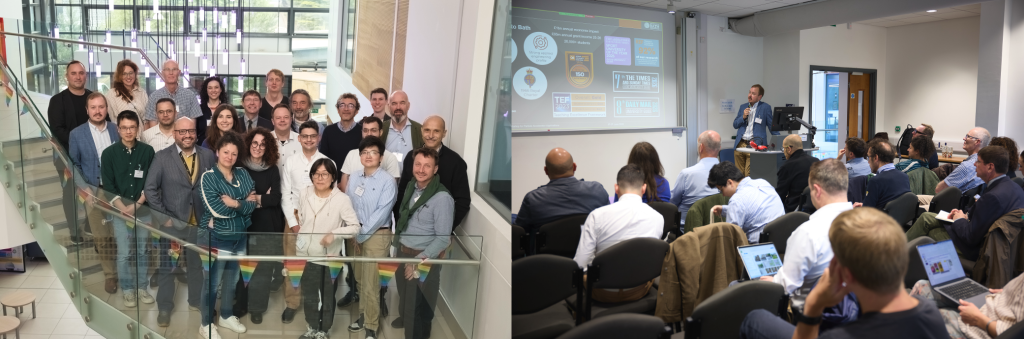
Researchers from CERN and more than ten partner institutes and companies across Europe, America and Asia met at the University of Bath on 8–9 June 2026 to discuss recent progress in low-density carbon materials and their potential for future accelerator applications. This matters because future high-intensity facilities, such as the High-Luminosity LHC, will use beams intense enough to push some materials currently used in the accelerator chain to their limits, motivating the search for alternatives able to tolerate these extreme conditions.
Low-density materials such as carbon nanotube (CNT) fibres and graphene interact less with the beam while possibly withstanding more heat and radiation than conventional materials. For CERN, this opens up many interesting application areas.
One example presented during the workshop: CNT yarns, developed through an ongoing collaboration between the Beam Instrumentation group and the University of Bath, for use in wire scanners, which pass a thin wire through the beam to measure its size and position. Tests in the HiRadMat facility showed that the CNT yarns remained stable under high-intensity proton beams, supporting their potential for future wire scanner upgrades.
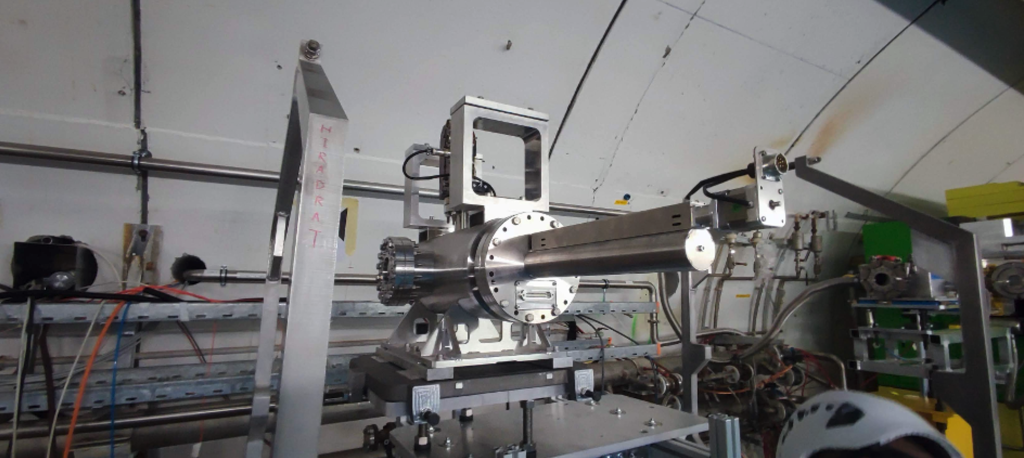
Image Credit: Gerard Aliana Cervera
Other active development areas at CERN include stripping foils in the injection chain and specialised targets used for the production of rare radioactive isotopes at the ISOLDE facility. At ISOLDE, a newly commissioned laboratory is producing nanostructured target materials for the first time, and early tests on a nanostructured uranium carbide target have already shown promising results. These are just some of the examples of how these materials could be used within CERN’s accelerator complex.
During the two days, also state-of-the-art CNT fibre production was presented by leading researchers and founders, including Prof. Matteo Pasquali (DexMat/Rice University) and Prof. Yoku Inoue (Hamamatsu Carbonics/Shizuoka University), who provided an up-to-date assessment of manufacturing capabilities and the remaining bottlenecks associated with their development and deployment.
Looking Ahead
While significant progress has been made across the field, discussions highlighted common challenges, including the need for greater standardisation and improved reproducibility. Organisers are preparing a proposal for EU funding to continue this work and a publication summarising the workshop is currently being submitted.
By bringing together experts from academia, research laboratories and industry, the workshop helped define common challenges and future research priorities. It also strengthened an emerging international community working at the intersection of advanced materials and accelerator technology, laying the groundwork for future collaborations and joint projects, with CERN continuing to be a key contributor to these efforts.
Further reading
- Additional information, the workshop programme and presentation material are available on the indico workshop website: https://indico.cern.ch/event/1660653/
- Article about CERN’s collaboration with the University of Bath: https://stories.bath.ac.uk/research-with-impact/becoming-cerns-engineering-partner/index.html
Organizing Comittee
Alexander J. G. Lunt (Department of Mechanical Engineering, University of Bath, UK)
Philippe Poulin (Université Grenoble Alpes, CNRS, Grenoble INP, France)
Mariusz Sapinski (Paul Scherrer Institute (PSI), Villigen, Switzerland)
Raymond Veness (CERN, SY-BI)
Chiara Pasquino (CERN, SY-BI)
Stefano Sgobba (CERN, EN-MME)
Thierry Stora (CERN, SY-STI)