Ensuring Electrical Integrity: ELQA’s Role in the LHC Long Shutdown 3
Contributors: Marta Vargas Jorba & Jaromir Ludwin.
On behalf of the LS3 coordination.
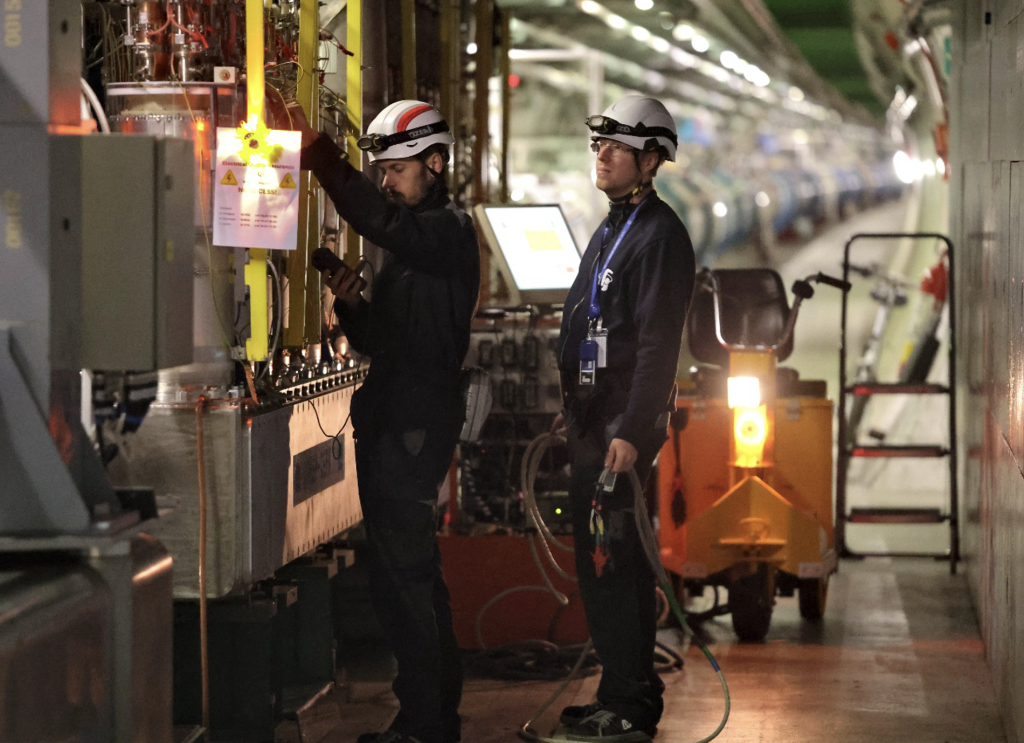
The Large Hadron Collider (LHC) has more than 1600 superconducting electrical circuits. They power the magnets that guide the beams around the 27 km ring. Every time the LHC stops for a major shutdown, all these circuits must be carefully checked following the switch-off and then again before switching them on. This is the job of the Electrical Quality Assurance (ELQA) team from the Technology Department (TE-MPE). During Long Shutdown 3 (LS3), the team is strongly engaged to prepare the LHC for its next phase: the High-Luminosity LHC.
ELQA carries out a wide range of electrical tests, and all of them must be finished and approved before the machine can be safely powered. Without them, the accelerator cannot restart.
The work follows three phases. First, the circuits are tested at cryogenic conditions as they are switched off to see if any changes have occurred after many years of operation. Then, after reaching room temperature, the circuits are again verified to ensure circuit integrity following the mechanical movements linked to the warm-up. ELQA will also support the replacement of four magnets in the arcs, the repair of 42 cold diode stacks used for magnet protection, the installation of the new HL-LHC inner triplet magnets, and many other repairs throughout the machine. Finally, each sector is tested again once the LHC is closed and cooled down, to make sure that we are ready for beam operation.
This is a big team effort involving colleagues from CERN and the Institute of Nuclear Physics in Krakow (IFJ PAN), Poland, with between ten and twenty people down in the tunnel every day for these activities.