
Collider-experiment interface: how engineers are preparing for manoeuvres in this highly restricted region of the HL-LHC
By Florence Thompson (CERN)
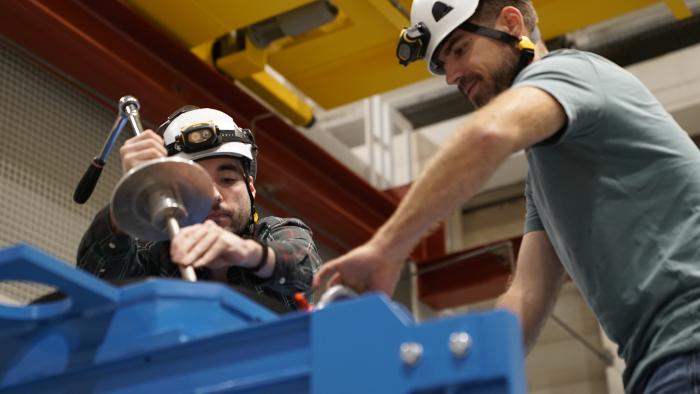
Engineers have started to use a life-sized mockup, named GALLUS V2, of the highly restricted region between the collision points and the tunnel at ATLAS and CMS, to test alignment and handling procedures.
The test bench was designed at CERN and recently completed – and two out of four of the TAXS modules to be handled in this challenging zone have been delivered to CERN – marking the start of the testing campaign.
TAXS
To protect the equipment in the tunnel from secondary particles produced by the collisions, there are four Target Absorber Secondary (TAS) modules. These are collimators (machine protection devices which absorb particles) made of copper which absorb the charged and neutral secondary particles.
One of these modules sits each side of both the ATLAS and CMS experiments, between the collision point and the final focusing quadrupole magnet (named Q1) in the tunnel on either side. For the HL-LHC, four new Target Absorber Secondary modules called TAXS will be installed to replace the previous LHC TAS modules.