Closing the Lifecycle of ISOLDE Targets
The ISOLDE target team (SY-STI), in collaboration with HSE-RP, has established a dedicated dismantling programme to safely process retired radioactive target and ion source assemblies accumulated over several decades. This joint initiative enables the elimination of these legacy targets through the Swiss Federal Interim Storage Facility, operated by the Paul Scherrer Institute (PSI)[1].
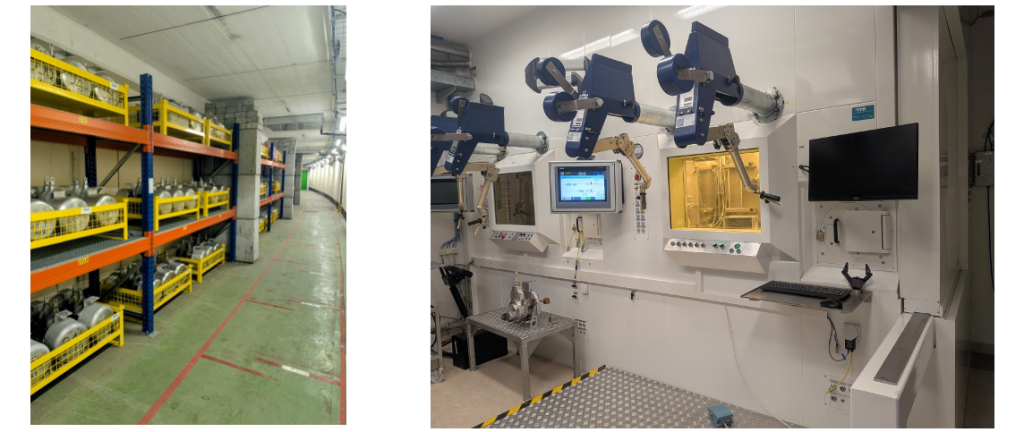
While often overshadowed by the experiments they serve, target and ion source assemblies, referred to as “targets” are at the heart of ISOLDE’s production of radioactive ion beams. ISOLDE and the associated CERN-MEDICIS facility operate around 35 target units per year. After each operational period, targets that have received a high number of protons, suffered mechanical failure, or shown degraded performance are transferred to dedicated storage facilities in the ISR for cooling before their dismantling. Before these units can be accepted as radioactive waste, further pre-treatment is required to meet CERN’s radioactive waste acceptance criteria.
The objectives are to ensure proper sorting of material, packaging and radiological characterization prior to elimination. Although ISOLDE has conducted target elimination campaigns throughout its more than 60 years of operation, increasing radiological inventories and the presence of irradiated uranium and thorium made manual dismantling impractical. This led to the procurement and commissioning of a dedicated alpha–gamma hot cell equipped with tele-manipulators for the safe dismantling and packaging of highly activated targets.
To meet the needs of ISOLDE’s diverse scientific programme, more than one hundred target and ion source configurations have been developed to efficiently produce and extract different isotopes. Although every effort is made to extend the operational lifetime of targets, through re-use and careful optimization, certain components inevitably degrade. Because of the intense irradiation they receive, and the use of uranium or thorium as target core materials during more than half of ISOLDE’s operating periods, target units become highly radioactive and contaminated.
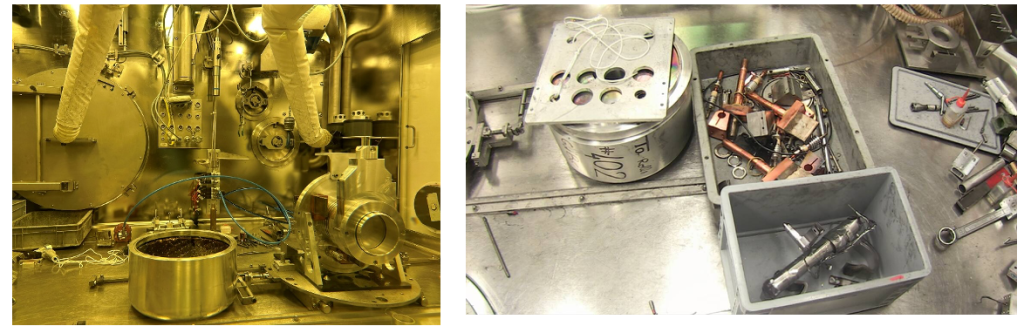
Remote handling systems and dedicated storage facilities are therefore required throughout their lifecycle. To safely process the targets, ISOLDE commissioned a dedicated alpha–gamma hot cell in 2022 within its “nuclear laboratories” in Building 179. The hot cell enables the remote dismantling and conditioning of irradiated targets in a shielded and dynamically confined environment. It consists of two compartments: one for the mechanical disassembly of target units and another for the treatment of uranium- and thorium-based materials prior to elimination. Operators perform all activities remotely using master-slave telemanipulators while protected from radiations by a 15 cm-thick lead shielding and lead-glass windows.
The hot cell is connected to the Building 179 nuclear processes ventilation system and operates under controlled under-pressure, ensuring dynamic confinement of airborne contamination. Multi-stage HEPA filtration and the possibility to work under an inert atmosphere provide additional protection during the handling and packaging of radioactive materials.
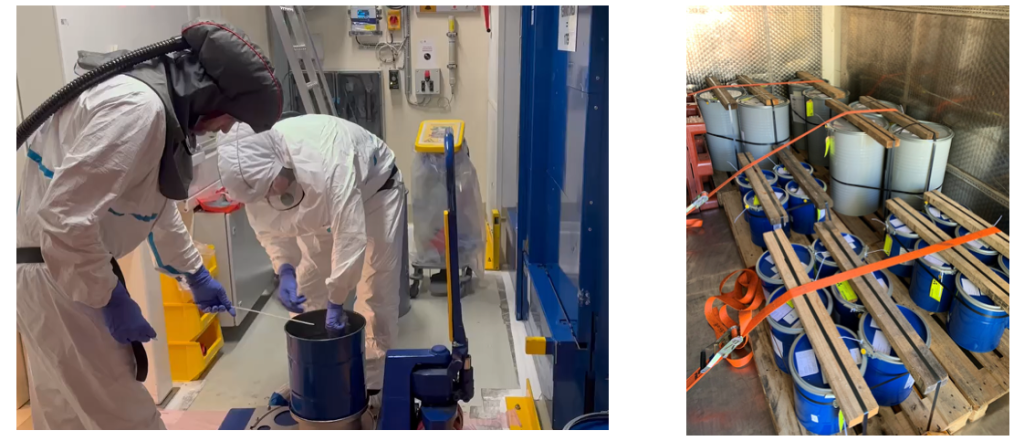
Since its commissioning, more than 130 targets have been dismantled and successfully conditioned for disposal, with their components sorted into three waste categories and packaged in separate drums. Through the continuous development of dedicated tooling and dismantling procedures, the processing rate has increased to approximately three target units being dismantled per week during dismantling campaigns. This achievement is particularly noteworthy, as the target assemblies were not originally designed for remote dismantling. Many components are held together by small screws and fittings that are difficult to access using telemanipulators. In addition, operating temperatures exceeding 2000°C, radiation damage, and storage periods of more than 30 years for some units have significantly complicated dismantling activities.
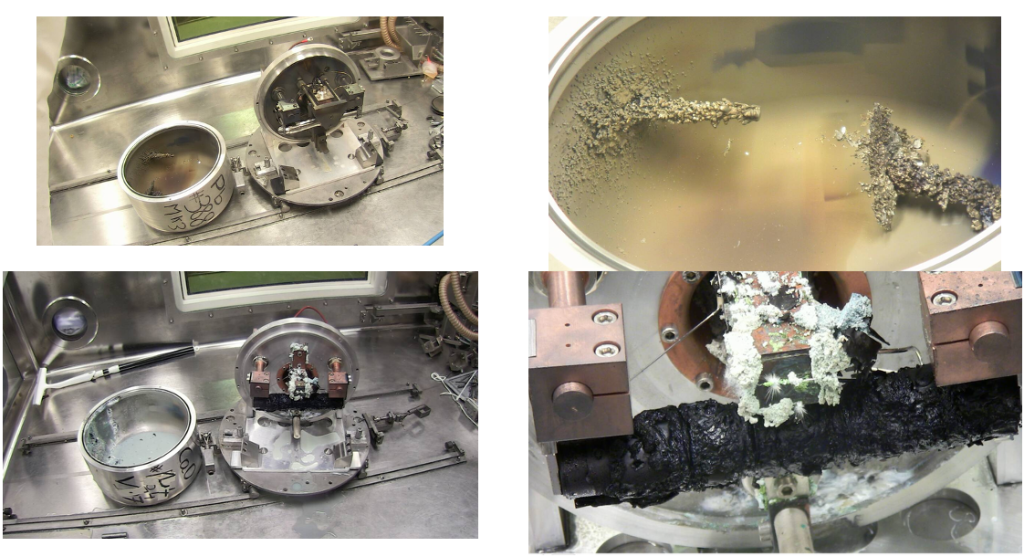
Looking ahead, the next challenge is the pre-treatment of irradiated uranium- and thorium-carbide targets, which have not yet been included in the dismantling campaigns launched in 2022. These materials, widely used at ISOLDE for radioactive ion beam production, are pyrophoric and require additional steps for chemical stabilization before they can enter a disposal route. Their irradiation during operation adds a significant radiological hazard, making the development of a remote stabilization process essential.
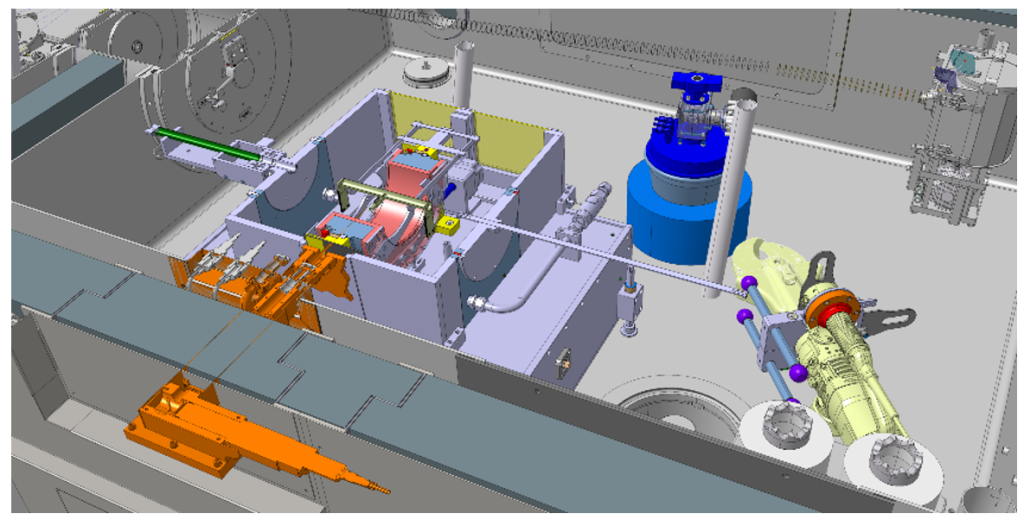
To support this objective, Hot Cell 2 is being upgraded and will be equipped with a laser cutting system to remotely open the tantalum target containers. The laser will operate inside an argon-inerted enclosure equipped with a rotating target holder (“revolver”), allowing safe and precise cutting. Following the opening of the target unit, a dedicated crushing reactor will be used to separate the graphite matrix and expose the carbide material to the stabilization process.
Studies with surrogate materials and non-irradiated uranium pills have demonstrated that controlled hydrolysis using humidified inert gas provides a promising route for stabilizing uranium, thorium and lanthanum carbides by converting the pyrophoric carbides into chemically stable compounds while limiting the system temperature and maintaining safe operating conditions. The ongoing programme aims to scale up this process for routine operation in the hot cell, where the stabilized material can subsequently be conditioned, packaged and characterized in accordance with the acceptance criteria defined by PSI for long-term disposal.
Beyond waste management, the hot cell also opens the door to more systematic post-irradiation examinations of target components, providing valuable insights into failure mechanisms and material degradation that can be fed back into the design process to improve the reliability and resilience of future target assemblies with the objective of reducing the among of radioactive waste produced.