
CERN Wins Cooling Best-In-Sector Award!
TheR744 Primary ATLAS & CMS SI detector cooling upgrade Project
P.Hanf/M.Battistin
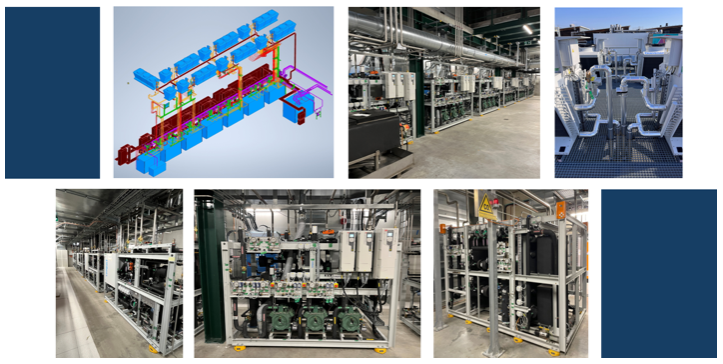
ATLAS Concept and realization
At the Atmosphere Europe Summit 2025, a leading international forum dedicated to accelerating the adoption of innovative, climate-friendly technologies, CERN was awarded Best-in-Sector / Industrial End User for its pioneering implementation of natural refrigerant-based cooling systems supporting the Phase-II upgrades of the ATLAS and CMS detectors. This recognition highlights CERN’s commitment to environmentally responsible research and acknowledges solutions expected to reduce greenhouse gas emissions by approximately 40,000 tons of CO₂ equivalent per year.
This achievement is the fruit of a remarkable collaborative effort spanning several years and involving multiple teams across CERN as well as industrial partners. In 2018, CERN, together with the ATLAS and CMS experiments, decided that the cooling systems for the thermal management of the future Phase-II silicon detectors would share a common design entirely based on CO₂ refrigeration technology.
The cooling systems are based on CO₂ vapor compression and comprise two compressor stages using trans-critical R744 equipment, coupled with a low-temperature secondary CO₂ pumped loop. The presentation during the summit focused on the solution adopted for the R744 primary system, led by the EN-CV group, while the secondary CO₂ pumped loop is managed by the EP-DT group.
The development of this innovative and unique refrigeration system followed standard engineering development cycle, during which the EN and EP departments successfully addressed numerous technical and organizational challenges through close collaboration.
These efforts contribute directly to CERN’s environmental objectives, supporting a targeted 28% reduction in direct (Scope 1) greenhouse gas emissions by the start of LS3 in mid-2026, compared with a 2018 baseline. More information is available in
CERN’s latest Environment Report: https://environmentreports.web.cern.ch/environment-report-2023-2024/emissions/.
You can also learn more about the new technologies being developed for High-Luminosity LHC: https://home.cern/resources/faqs/high-luminosity-lhc