
ATLAS forward-region beam vacuum assembly enters retirement
By Joseph Sestak, TE/VSC
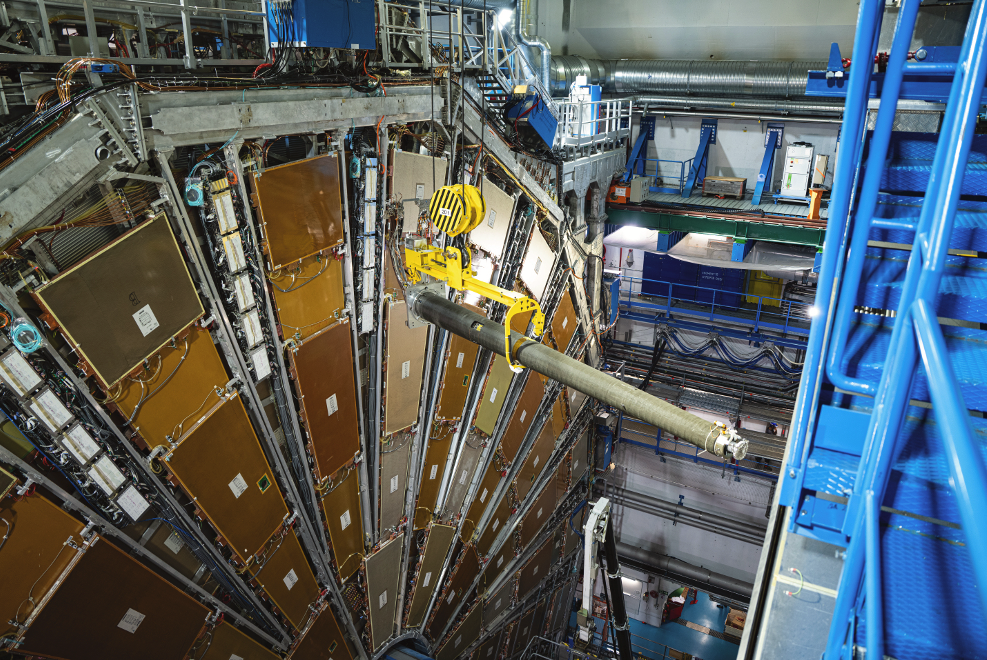
More pictures https://cds.cern.ch/record/2966736?ln=en
After more than a decade of service, a key component of the LHC beam vacuum system in the ATLAS experiment has been successfully removed, making way for the High-Luminosity LHC era.
Installed during Long Shutdown 1 (LS1), the 5.8-metre-long aluminium beam vacuum assembly formed part of the beam line passing through the forward region of the ATLAS experiment. Located between the ATLAS big muon wheel and the endcap toroid, it provided the ultra-high-vacuum environment required for the LHC beams to travel through the experiment.
The assembly was the second generation of this component. It replaced an earlier stainless-steel design, with aluminium chosen to reduce the amount of material around the beam line, helping to limit radiation exposure and minimise unwanted background signals in the ATLAS detector.
After more than ten years of operation, removing the 300 kg assembly presented a significant technical challenge. Suspended from a crane in the ATLAS underground cavern, almost 100 metres below ground, it had to be carefully manoeuvred through the densely packed experiment. At several points along the extraction path, only a few centimetres separated it from neighbouring components.
The operation was further complicated by the radiological conditions in the area, requiring careful preparation to minimise personnel exposure while ensuring that the assembly could be safely disconnected, handled and removed. Its successful extraction was the result of detailed planning and close coordination between the ATLAS and CERN technical teams.
The retirement of the assembly also marks the beginning of a new chapter. A new beam vacuum assembly developed for the High-Luminosity LHC (HL-LHC) will take its place, designed to meet the more demanding conditions of the upgraded accelerator and experiment.
The removal closes more than a decade of reliable service and recognises the contribution of the many engineers, technicians and physicists who took the assembly from design and installation through operation to its final removal – while preparing the way for the next generation of LHC physics.