
All Systems Go – Slawosz in Space
Opinion Piece: benjamin.todd@cern.ch
On Wednesday June 25th 2025 at 06:31 UTC, Axiom Space launched their 4th crewed mission, AX-4, to the
International Space Station (ISS), from Cape Canaveral, Florida,. Aboard were four astronauts: mission
commander Peggy Whitson, pilot Shubhanshu Shukla, mission specialist Tibor Kapu, and from CERN –
mission specialist Slawosz Uznanski-Wisniewski.
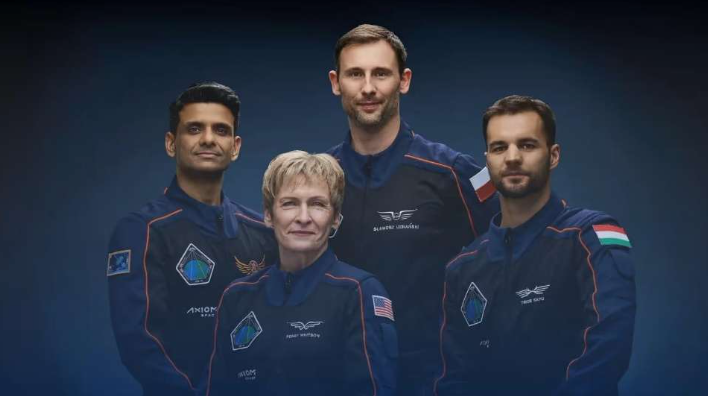
Image Axiom Space
Just three years ago Slawosz was engineering converter controls in SY-EPC-CCE, although you mayremember Slawosz from his time as converter controls engineer, radiation effects expert, from the YachtClub, or as LHC Engineer in Charge – or you may have crossed paths with him on one of his combinedskiing and mountaineering expeditions. What followed has been an incredible transformation.
From the SY-EPC-CCE view, Slawosz’ astro-story began back in autumn 2022, after I received a strangephone call from Slawosz; saying “… I may need to leave CERN for a while…”, quite an understatement.
It transpired that in his spare time, throughout 2021 and 2022, Slawosz had been progressing through the ESA astronaut selection programme: 22,500 applicants were whittled down to a final selection of 17through six screening exercises. This process culminated at the end of 2022 with Slawosz being selected asa member of the ESA Astronaut Reserve: A remarkable achievement! But reserve was never the finalobjective, it was only the beginning, for Slawosz.
Throughout 2023, Slawosz set out to convert this reserve spot into a fully-fledged astronaut position:meeting people, sharing his vision of space, pushing to represent Poland and Europe on the world stage, andaligning political circles to connect the right people to the right people, to making this dream a reality. Thisculminated in Slawosz joining ESA as a Project Astronaut in September 2023, to begin the 18 monthstraining needed for the Axiom Space AX-4 Mission.
Slawosz joins the ranks of previous CERN personnel who have made the giant leap from High Energy Physics to space; Ernst Messerchmid, a German researcher who worked as a fellow on the IntersectingStorage Rings in the 1970s, and who flew aboard Challenger in 1985. And Christer Fuglesang, who workedat CERN as a fellow in the 1980s on the CPLEAR and helped lay the groundwork for the LHC, who flew tospace on Discovery in 1996, becoming the first Swede in space. Some three decades later Slawosz hasbecome part of this legacy, representing Poland, the European Space Agency, becoming the first Pole tovisit the ISS, and the second Pole in space after Mirosław Hermaszewski in 1978.
A few of Slawosz’s friends and family were invited by Axiom Space and ESA to take part in a final wave-off event in Florida, in the days before the planned launch, after Slawosz had gone into quarantine, I was lucky enough to be part of this event. Having spoken to Slawosz a few times before his launch, it seemed quite low-key; “Slawosz was going to space for a while”. Arriving in Florida, my understanding completely shifted; such energy from friends and family, larger-than-life-size posters of Slawosz on the seafront, Axiom Space advertisements in all corners. Florida is a space nexus, with people from the world joining there towish Slawosz and his crew well
For the wave-off event itself, I should set the scene, a police motorcade surrounding a bulletproof minibuswith black windows and black doors… Out steps Slawosz, and his crewmates, onto a podium to talk about his ambitions, space, and the journey he is on.
Slawosz was wearing three patches, including his own named “IGNIS”; Ignis represents the spark of Polandre turning to space after 47 years, featuring the national symbol eagle, Orla Perć mountain wings, and the Scutum constellation, discovered by the Pole Johannes Hevelius.

Hearing Slawosz speak, one thing immediately struck me – clearly, Slawosz is not coming back to fix our legacy converter controls in AD. Slawosz spoke of the significance of space, the opportunities it presents to build connections between Poland, Europe, space and science, and the impact his supporters have on him. It was an inspiring moment, gracefully rounded off by 60 people singing Tom Wlostowski’s and Aleksandra Rutczynska’s reworking of Meskie Granie Supermoce!
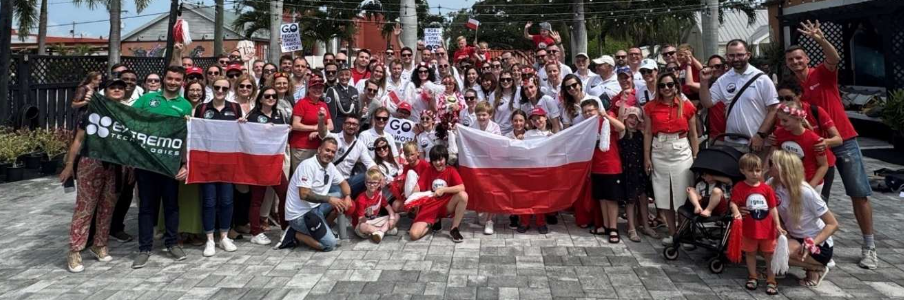
Supporters of Shubhanshu and Tibor were also there, to wish their compatriots well, then the motorcade returned, the bulletproof minibus reappeared, and Slawosz and his crew were whisked away to their next commitment.
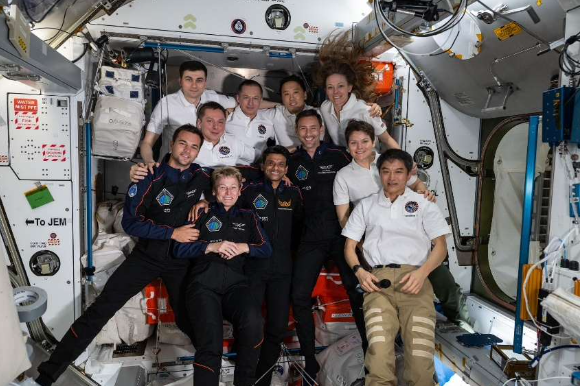
A day after launch, AX-4 docked with the ISS, where the Axiom crew met the Expedition 73 Crew – Shortly afterwards, Slawosz finally had his astronaut pin attached: Astronaut #635.
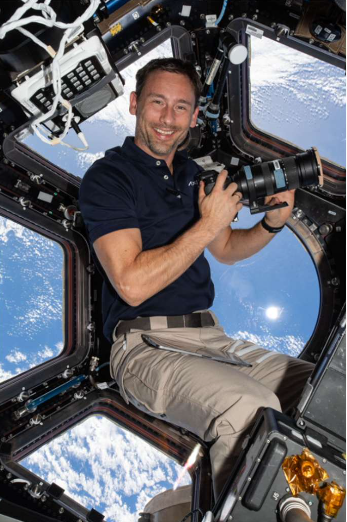
Slawosz is scheduled to return on the 14th July, and for these two weeks on the ISS he will be carrying out around 60 science experiments in microgravity: many of which have designed by youngsters from Poland, including cooking his favourite pierogi.
This whole event, and experience has given me immense pride, and has showcased what the people who work with us, and for us, are going on to achieve. In Florida I met past colleagues who have themselves gone on to superb careers beyond CERN; from music industry gold to Starlink conception, and a myriad of things in between. CERN, and in particular our accelerator sector, and this systems department is training and equipping people to go beyond CERN and make a difference, learning the core technical and behavioural skills which are crucial to successful high-tech careers.
I think every scientist or engineer has a fundamental passion for space at some level, since Alan Shepard in 1961, through the 1969 moon landings, then the space shuttle. Going to the Kennedy Centre, you can feel
the inspiration that these pieces of engineering generate. CERN shares this same DNA, exploration for exploration’s sake, albeit at a different scale; at the smallest end of the universe, rather than the largest.
On the other hand, what struck me the most, beyond the people I met, was the political change in space that has happened in the USA since the 2010s, programs used to be governmental, driven by NASA, with suppliers for NASA; today that’s changed, Axiom Space, Space-X, are private companies: add to this Boeing with Starliner, Blue Origin with New Shepard, Sierra with Dream Chaser – all of these companies established by contracts to deliver a service to NASA. This generates an incredible rate of change. It was only in 2020 that Space-X carried out their first crew launch demonstrator. In five years since, Space-X launched 11 manned missions as part of NASA’s commercial crew program, and 7 manned private flights, including this Axiom-4 with Slawosz, completely revolutionising the space business for the USA, all the while maintaining the high dependability needed for human flight. In the first 6 months of 2025 there have been 79 Falcon 9 launches by Space-X, reusing their boosters. Their objective is reducing the cost to Low Earth Orbit; Falcon 9 achieving $2700/kg, Space-X aiming for $100/kg with Starship, when it doesn’t explode. Space being the ultimate market, the whole world the ultimate client.
To put this in context, in Europe meanwhile Ariane 6 launched for the first time last year, with a first commercial flight this year, ultimately aiming for 10 launches a year. Space-X already launching 15x per month. It seems an example of the Europe vs. USA risk profile, where more money with more appetite for risk, means more results and more market. In Europe more conscientious and cautious over risk, finding concessions and commonality, but coming at a slower rate.
There must be a middle ground, where Europe could take slightly more risk to unlock greater impact and more competitiveness. Slawosz’s journey, from SY-EPC-CCE engineer to astronaut, somehow captures thatspirit: taking a chance on making a difference.
Bravo, Slawosz!
Re-watch the launch on Axiom-Space’s YouTube Channel.
Connect with Slawosz on his Facebook, LinkedIn, X