
Ahead of the Wave: Early-Warning Digital Twin Converts Seismic Motion into Infrastructure Intelligence
By Oscar SACRISTAN
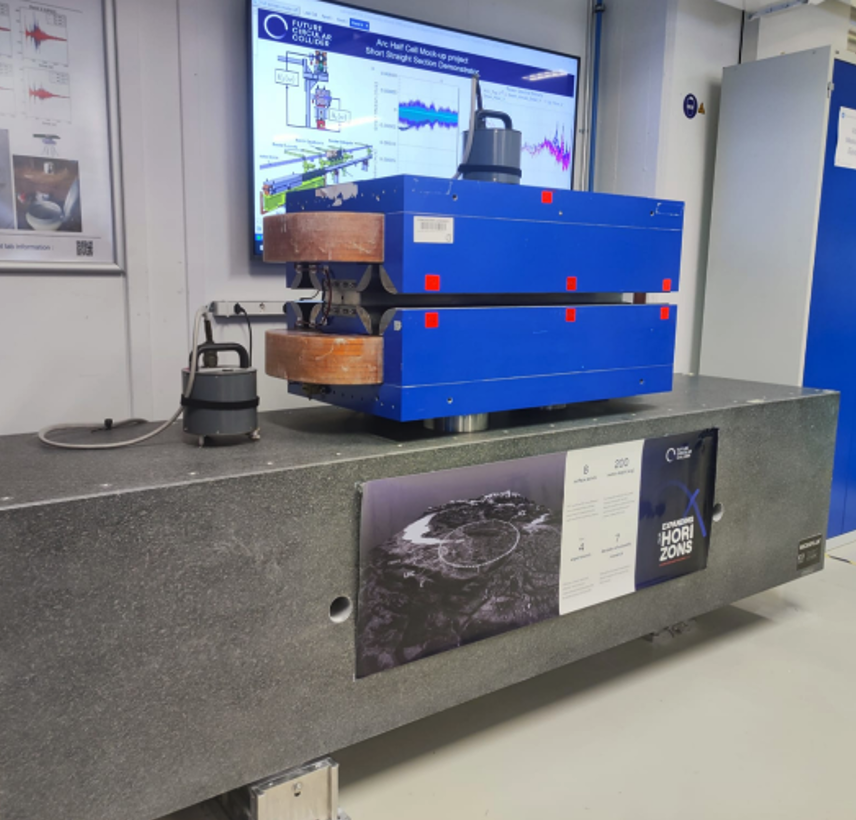
Developed within the framework of the EN-MME Digital Twins initiative, a multidisciplinary collaboration across CERN teams has demonstrated a real- time predictive Digital Twin that converts ground motion into instant impact assessments for future colliders.
As design and feasibility studies for next-generation, ultra-high-energy colliders advance, ensuring beam stability at sub-nanometre scales presents an un precedented engineering challenge. At these extreme precisions, environmental disturbances—ranging from regional microseisms to distant seismic events—propagate through the surrounding geology, perturbing magnet support structures and threatening accelerator luminosity. To guarantee the operational performance of future high-precision machines, treating environmental physics as an integral part of the accelerator complex has become paramount.
To address this challenge within the framework of the Digital Twins initiative, engineers and physicists have deployed a functional, real-time Early Warning Digital Twin. Rather than simply analysing ground motion after a beam dump or displacement occurs, the system continuously monitors external seismic activity, to predict infrastructure response some seconds before physical waves reach the site.
The CERN Seismic Network and Regional Integration
The project’s physical foundation rests on the CERN seismic network, designed, installed, and maintained by the CERN Mechanical Measurement Lab. Deployed across surface and underground caverns over a decade ago, this dedicated network serves as the ground-truth” sensory system” required to characterise local geology and validate physics-based structural models.
However, local monitoring alone cannot provide early warning. To extend lead times, the CERN seismic network was fully integrated into the regional observation system of the Swiss Seismological Service (SED). By continuously streaming data from seismic stations across Switzerland, the Digital Twin observes incoming ground disturbances tens to hundreds of kilometres away from the Geneva basin, long before they reach CERN’s infrastructure.
CERN IT Infrastructure: The Digital Nervous System
Transforming raw continuous streams into immediate predictions requires a high-throughput, low-latency data architecture. Developed in close partnership with the Analytics Streaming and Monitoring IT section, the platform serves as “digital nervous system”. It continuously screens incoming streams, identifies relevant events, automatically fetches waveform data, and routes it directly to execution pipelines.
“In early warning engineering, latency is an intrinsic property of the pre-diction itself. A perfect model delivered after a seismic wave hits the tunnel has zero operational value. CERN IT’s real-time data infrastructure allows us to execute the complete pipeline in sub-seconds.”
Infrastructure-Centric Intelligence for Future Colliders Upon receiving data, a multi-model predictive engine —combining physics-based transfer functions and K-nearest neighbours (KNN) algorithms— calculates expected mechanical displacements across specific magnet girders. This marks a major paradigm shift: moving from generic event detection (“A magnitude 4.0 earthquake occurred 50 km away”) to infrastructure-centric intelligence (Predicted 1.2-micrometer vertical displacement at quadrupoles in T-minus 8 seconds). This successful demonstrator under the Digital Twins initiative proves that external physical disturbances can be anticipated in real time. As CERN looks toward the FCC, this connected predictive capability provides a crucial technological milestone to safeguard beam stability in next-generation colliders.