
Advancing Access to Radiotherapy – STELLA Project Concludes 18-Month Phase
By Amedeo Habsburg
The STELLA (Smart Technologies to Extend Lives with Linear Accelerators) project has completed an 18-month research and system design phase funded by the U.S. Department of Energy. Led by the International Cancer Expert Corps (ICEC) and CERN, with academic partners from the Universities of Cambridge, Lancaster, and Oxford, the project focuses on addressing long-standing gaps in access to radiotherapy in low- and middle-income countries (LMICs).
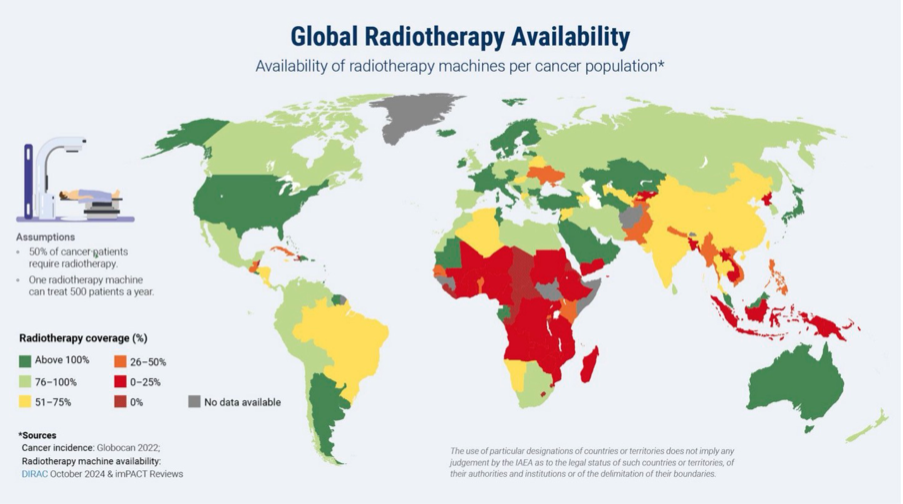
Radiotherapy is required in approximately 50% of all cancer treatments, yet access remains highly uneven. Most radiotherapy facilities are located in high-income countries, while many LMICs face frequent equipment downtime, shortages of trained personnel, and limited maintenance capacity. These constraints often result in delayed or interrupted treatments, with direct consequences for patient outcomes. STELLA was initiated to explore whether a radiotherapy system could be designed from the outset to better match these operational realities.
The project’s objective is to define a cost-efficient and serviceable Radiotherapy Training and Treatment (RTT) system architecture. STELLA integrates four closely linked areas: hardware design, software and AI tools, training models, and a sustainable business approach. Rather than developing a single component, the project addresses the full system, from beam generation and imaging to clinical workflows and long-term operation.
Over the 18-month period, the consortium completed a comprehensive hardware specification covering six main subsystems, including the accelerator, gantry, collimator, imaging, surface tracking, and patient couch. The specifications emphasizes modularity, simplified mechanics, and defined interfaces to facilitate local maintenance and reduce reliance on external service teams.
On the software side, STELLA developed and tested several proof-of-concept tools. These include a unified operations and treatment console, AI-based predictive maintenance models using machine log data, image de-noising algorithms for cone-beam CT, and tumour segmentation tools for selected clinical sites. A system-level software wireframe was developed to define clinical, technical, and maintenance workflows and streamline routine staff tasks.
Training activities focused on understanding workforce constraints in LMIC settings and identifying how training could be embedded into the system design itself. Workshops with clinicians, medical physicists, and engineers informed requirements for modular, scalable training approaches.
Finally, work on the business model examined pathways toward manufacturing, deployment, and long-term operation, with an emphasis on reducing total cost of ownership and system downtime through service-based models and knowledge transfer.
With this phase complete, STELLA has established a consolidated system design and validation framework. The project has been extended by one year, to enable further engagement with design and manufacturing partners and to continue development of the system software, training approach, and business model. With CERN’s main deliverables completed CERN will contribute on a more limited and advisory basis during the extension phase.