
Accelerator Report: The 2026 run will be short but intense
By Bettina Mikulec, Leader of the Operations Group (BE-OP)
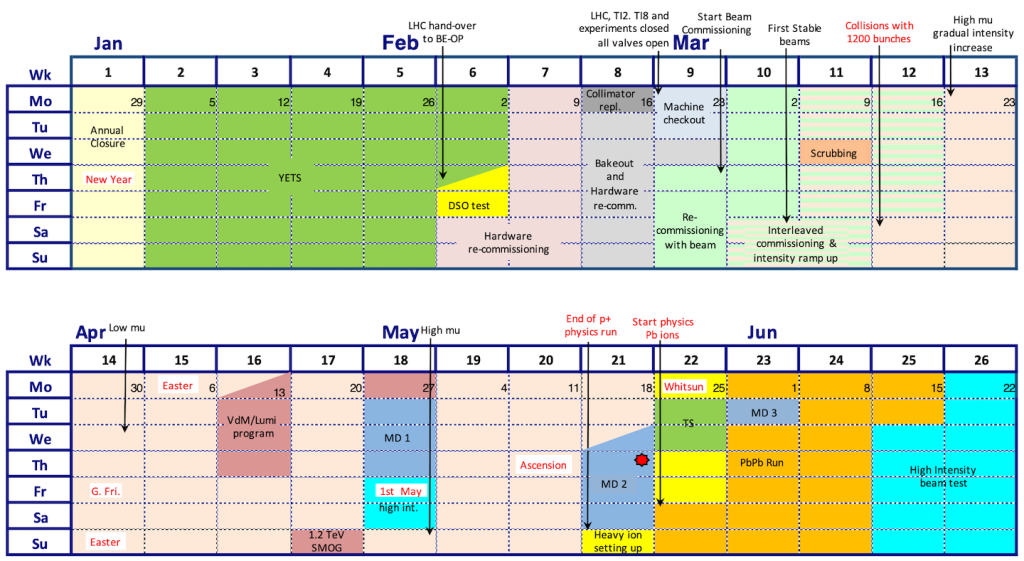
During the recommissioning phase, the operations teams, together with equipment and machine-protection experts, worked around the clock to bring the Large Hadron Collider (LHC) back into operation. Finally, on the afternoon of Saturday, 7 March, stable beams for physics data taking were declared for the first time in 2026. This milestone marks the beginning of the final LHC data-taking run before the High-Luminosity LHC (HiLumi LHC) upgrade.
With Long Shutdown 3 (LS3) scheduled to begin at the start of July in the case of the LHC, the 2026 run will be short but densely packed. Every day counts, and the operations teams have mapped out a precise sequence of running phases to maximise the physics output during the machine’s final months.
The LHC restarted with just four bunches circulating per beam. Over the coming weeks, this number will gradually increase to more than 2400 bunches per beam. This intensity ramp-up is not simply a matter of injecting additional bunches: at each new intensity step, beam stability, beam losses and beam-induced effects – such as electron cloud and equipment heat-up – must be carefully assessed before proceeding further.