Accelerator Report: A strong finish and a swift transition into the winter break
The 2025 run was successfully completed on 8 December at 6.00 a.m., signalling the start of the year-end technical stop for the LHC and the injector complex
By Rende Steerenberg
The early morning of 8 December offered a reminder that, in accelerator operations, not everything always goes according to plan. During the final weekend of the 2025 LHC run, the machine had been running almost like a Swiss clock, with short turnaround times (i.e. the interval between dumping one fill and declaring stable beams for the next) and with most fills being dumped by the LHC Engineer in Charge.
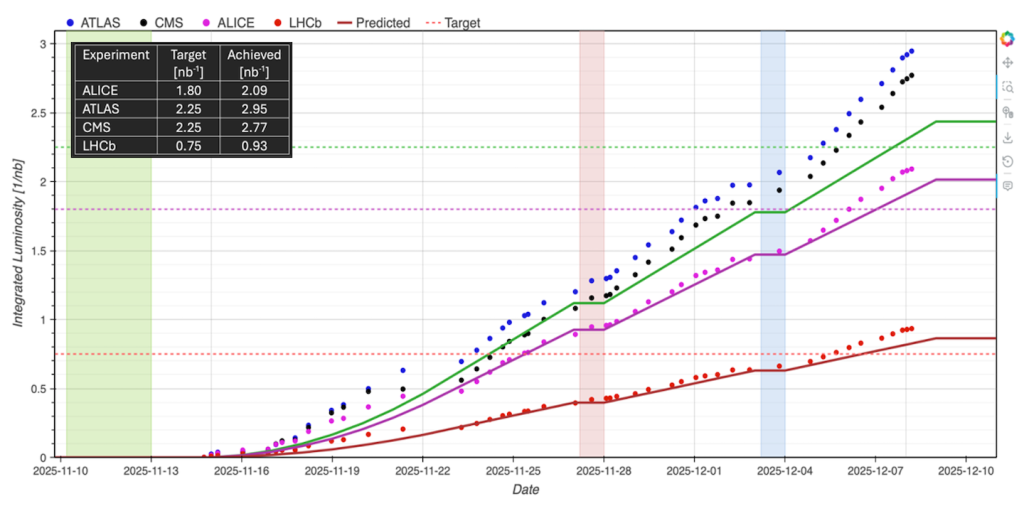
At 2.50 a.m. on 6 December, ALICE was the last of the four experiments to reach its integrated luminosity goal for 2025. With more than 50 hours remaining before the scheduled end of the run, it looked like there was ample time to exceed the year’s targets. The LHC continued to perform well, but early on 8 December, some end-of-run equipment tiredness seemed to creep in. The final two fills of 2025 were dumped by the machine protection system due to faults in one of the radiofrequency power transmission lines. The first at 1.33 a.m. on 8 December, and the second at 4.34 a.m., which turned out to be the last beam dump of 2025. Only 1.5 hours remained until the planned end of the run.
Once again, this end-of-run episode highlights a familiar truth: we can plan meticulously, but reality always has the final say.