
Making Way for Higher Luminosity: The D1 Separation Dipoles Removal
By Contributors: Marta Vargas Jorba & Pierre Alexandre Thonet on behalf of the LS3 coordination.
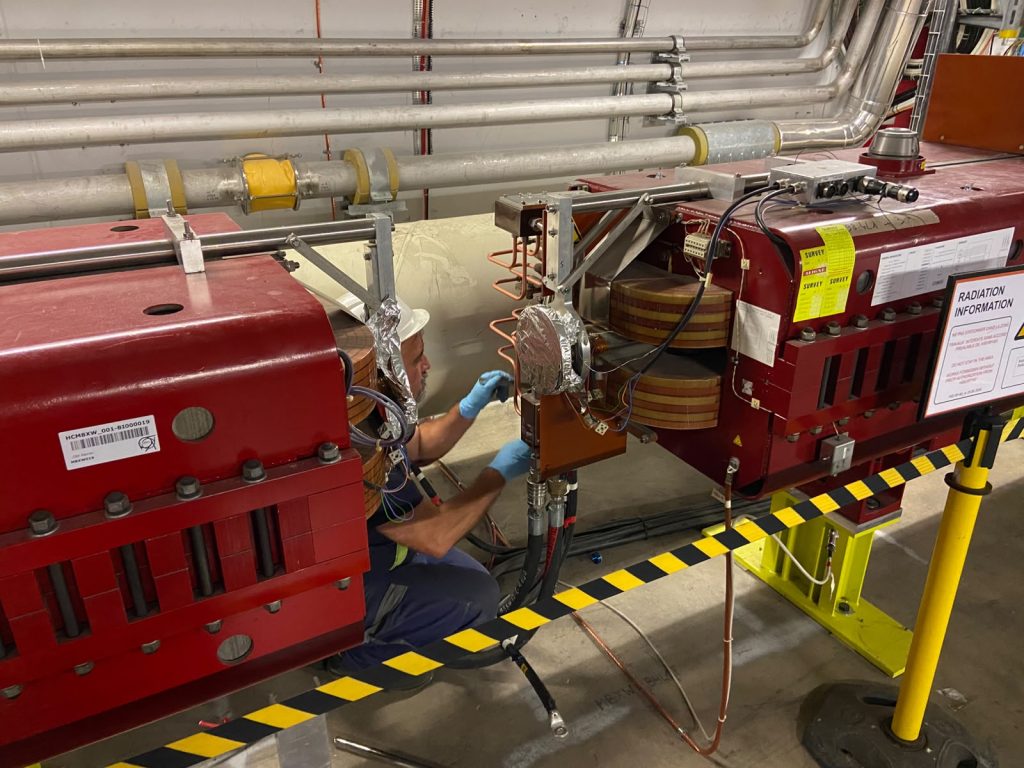
Inside the LHC, the two particle beams run side by side in opposite directions, kept at a distance of 194 mm from each other for most of their 27 km journey round the ring. At the collision points, the beams need to be brought together in a common vacuum chamber so that particles can collide. In IR1 for the ATLAS experiment and IR5 for the CMS experiment, this is achieved by a set of normal conducting magnets called D1 separation/recombination dipoles, which steer the beams towards each other just before the collision point.
Each D1 system is made up of six magnets (known as MBXW), placed on either side of the collision point. These magnets have been running reliably since the LHC first started up in 2008.
In September 2026, only two months after LHC entered LS3 mode, the MBXW magnets were taken out as part of a major upgrade programme called the High-Luminosity LHC (HL-LHC). They will be replaced by a new, more powerful variant using superconducting technology. The new magnets have a larger opening for the beam, necessary to accommodate the higher beam intensities and larger crossing angles in the HL era. The use of superconducting technology allows them to be shorter, making room for an additional system called the crab cavities.
Taking out the old magnets was a complex operation that brought together many different teams marking an important milestone, successfully met according to the optimised schedule thanks to the expertise of many teams, specialists in magnets, vacuum systems, electrical networks, alignment surveys, civil infrastructure, and equipment transport and handling.