
Dismantling the CMS beam vacuum system for the HL-LHC upgrade
Removing one of the LHC’s longest vacuum chambers during Long Shutdown 3
By J. Sestak
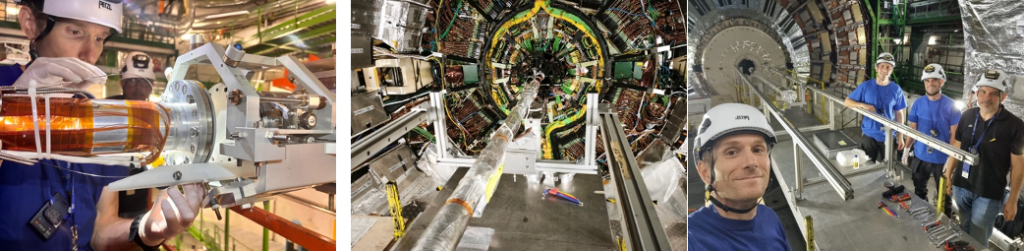
The LHC beam vacuum system belonging to the CMS experiment spans 44.36 m around Interaction Point 5 and comprises three different beam vacuum sectors. The most significant of these, IP5.X, extends over 38 m within the experimental cavern UXC55. Its thirteen custom-made vacuum chambers were built between 2016 and 2020, successfully installed in 2021 after two months of daily effort during Long Shutdown 2. After its commissioning, the whole system was smoothly operated throughout LHC Run 3 with ultimate pressure in 10-11 mbar range. The central element is a 6.2 m long, 0.8 mm thick chamber, made partly of aluminium and partly of pure beryllium, that connects to a 7.4 m long aluminium end-cap chamber — one of the longest chambers in the entire LHC machine.
To make way for the upgrade of both the CMS detector and the HL-LHC machine during Long Shutdown 3, the system must be completely dismantled. Each sensitive component has to be handled with great care while keeping the time personnel spend in the area to a minimum, owing to radiological constraints — a procedure captured in a WDP comprising over 300 steps across six different teams.
To build familiarity with the sequence of actions — including the various unexpected scenarios that might arise — and to ensure that the special tooling functions correctly, the BVO team for the LHC experiments carrying out these operations rehearsed the most delicate manipulations in advance, such as decoupling the forward region, on the mock-up in the surface laboratory. At present, most of the system has already been extracted and stored on the surface of the experiment, awaiting its return in 2029.