
Automation in Accelerator Beam Transfer
This article summarises the recent developments in equipment automation within the Accelerator Beam Transfer group (SY-ABT) to reduce downtime and improve machine availability.
By Patrick Ellison, Francesco Maria Velotti, Malik Marco Algelly (on behalf of SY-ABT AI and Automation Working Group)
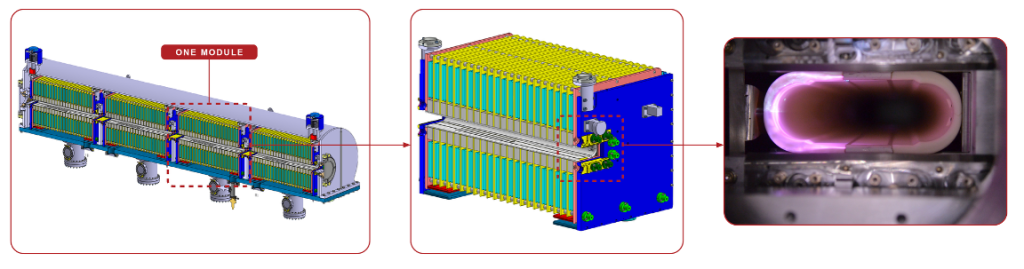
Future particle accelerators will reach higher collision energies and beam intensities, requiring larger facilities holding ever more equipment. Even within CERN’s accelerator complex today, a large share of operational time is already spent diagnosing, repairing and recovering from equipment and system failures. As complexity grows, automating both equipment recovery and routine processes will be essential to minimise downtime and keep the machines available for physics.
The pressure is already being felt. During the past year’s high-intensity studies in the SPS, the repeated conditioning of the injection kickers placed a heavy load on the on-call piquet teams. In the PS, the extraction kicker magnet KFA71 was itself a steady source of downtime, with its ageing control system one of the main culprits. While its controls will be consolidated in Long Shutdown 3 (LS3), an immediate solution was needed to help ensure the high levels of reliability that are required from KFA71.
At the start of the year, SY-ABT set up the AI and Automation Working Group, with representatives from across all of its sections. Its remit is broad: to coordinate efforts to automate equipment and operational processes, and to apply artificial intelligence and machine learning across ABT’s activities. Two cases were selected for the first round of development: automated fault recovery for KFA71; and automated vacuum-interlock recovery for an injection kicker magnet in the SPS (MKP).
For KFA71, the Operations group (BE-OP) and SY-ABT had already built an automated recovery system designed to reduce downtime from minor, non-critical faults and to avoid “blind” manual resets. Within the Efficient Particle Accelerators (EPA) project, and specifically its Automate Equipment work package, an updated version of this system was developed and deployed as one of the package’s main pilot projects. It is built with AqFlow, the automation framework prototype being developed for EPA. The new system uses AqFlow’s built-in tools to alert experts whenever a recovery takes place and to record each event in the operations logbook, with a link to an automatically generated snapshot of the relevant machine data (viewable in TIMBER).
Deployed on 23 May 2026, the system has already completed fifteen successful recoveries on the real hardware. In its very first week, the improved fault traceability revealed a recurring stability fault; armed with this, the expert could adjust the machine settings, making the fault less frequent and improving availability.
The MKP case is more demanding. At high beam intensity, this magnet can suffer from spark-induced vacuum faults, which need both a reset of the equipment and a manual high-voltage conditioning step before the magnet can be used again. Unrelated pressure spikes can trip the same safety interlock without any conditioning being needed, and until now distinguishing between the two required expert analysis. To automate this, a neural network was trained to recognise which event triggered a given fault, reaching close to 100% accuracy on historical data from 2023. In parallel, an automation agent was built to execute the conditioning process, with a trial deployment on the real magnet now under way. The current focus is on feeding the neural network’s result directly into the conditioning agent, so that the full recovery becomes automatic.
While the KFA71 and MKP cases were low-hanging fruit, solving them gave the team operational experience, supporting tools and a reusable framework that together make new automation far quicker to build. This meant that when a re-arm problem was recently detected in the SPS beam dump, it was possible to develop and deploy a fully automated re-arm system within a single day.
This work is still ongoing, but the early results already point to three requirements for trustworthy equipment automation: the status and outcome of every automated action must be clearly visible; the condition of the equipment must stay easy to monitor; and experts must remain in control of recovery at all times.