
FCC robotics prototype enters validation phase in the FCC Arc Cell mock-up
By BE CEM Group
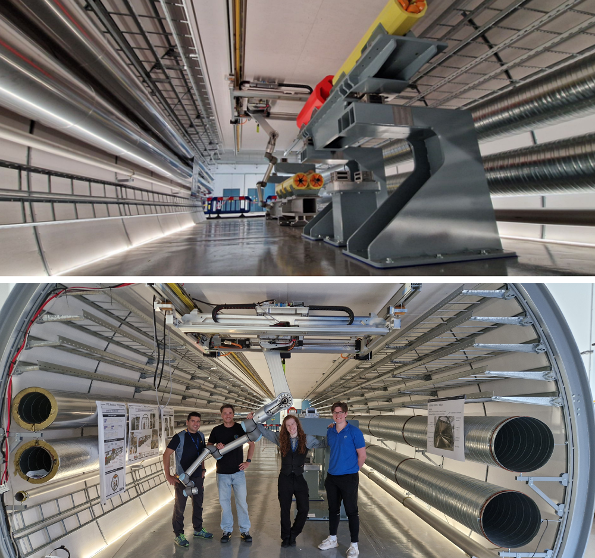
The Remote Maintenance and Inspection System (RMIS) prototype is now being integrated in the FCC Arc Cell mock-up in CERN Buildings 355-358. The platform will be used to validate remote maintenance tasks, HSE activities, tooling, integration choices and intervention procedures for future FCC operations.
A robotics-ready validation platform for FCC
The FCC studies have identified robotics as an integral part of the future machine availability and safety concept. The RMIS prototype brings this approach into a realistic tunnel-like environment where concepts can be transformed into validated engineering requirements.
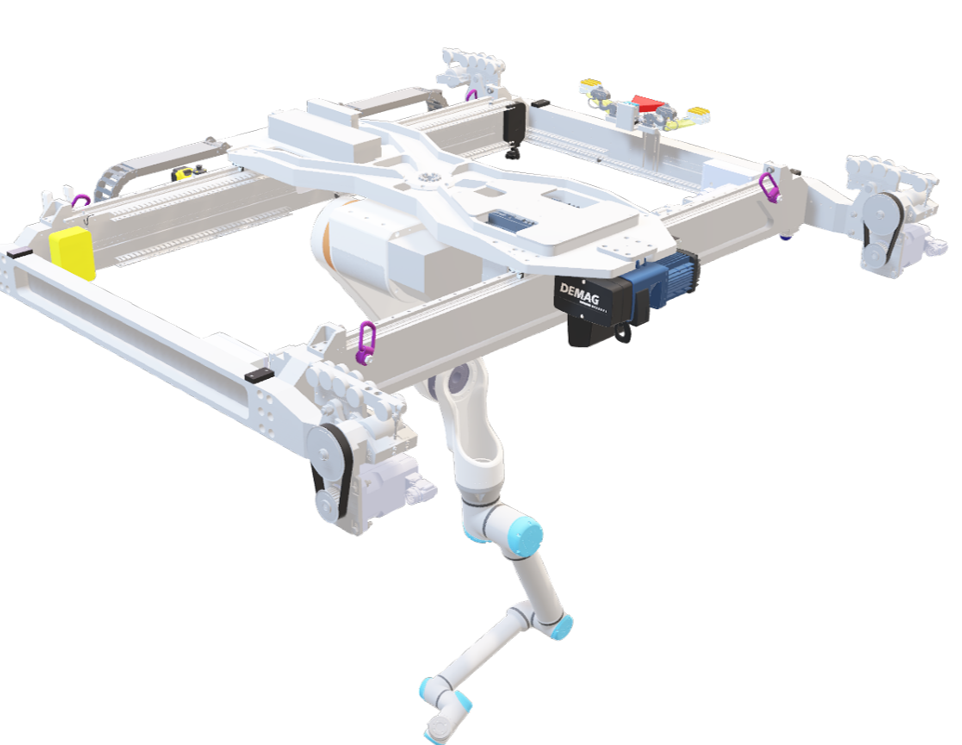
The system combines a bridge-frame robot, a transverse trolley, a robotic manipulator, an integrated hoist and a dedicated tool magazine. It is designed specifically for the Arc Cell mock-up and remains open to future upgrades and full-scale FCC requirements.The installation marks an important step towards a standardised Code of Practice for robotics-assisted maintenance: infrastructure, interfaces, tools and operational procedures can now be tested before the final accelerator design is frozen.
At a glance
Location: FCC Arc Cell mock-up, CERN Buildings 355-358
Mock-up length: 29 m, with robot rails, power/data rails and barcode tape
Prototype: Remote Maintenance and Inspection System (RMIS)
Robot capabilities: 12.5 kg manipulator payload, 160 kg hoist payload, 10 km/h maximum speed
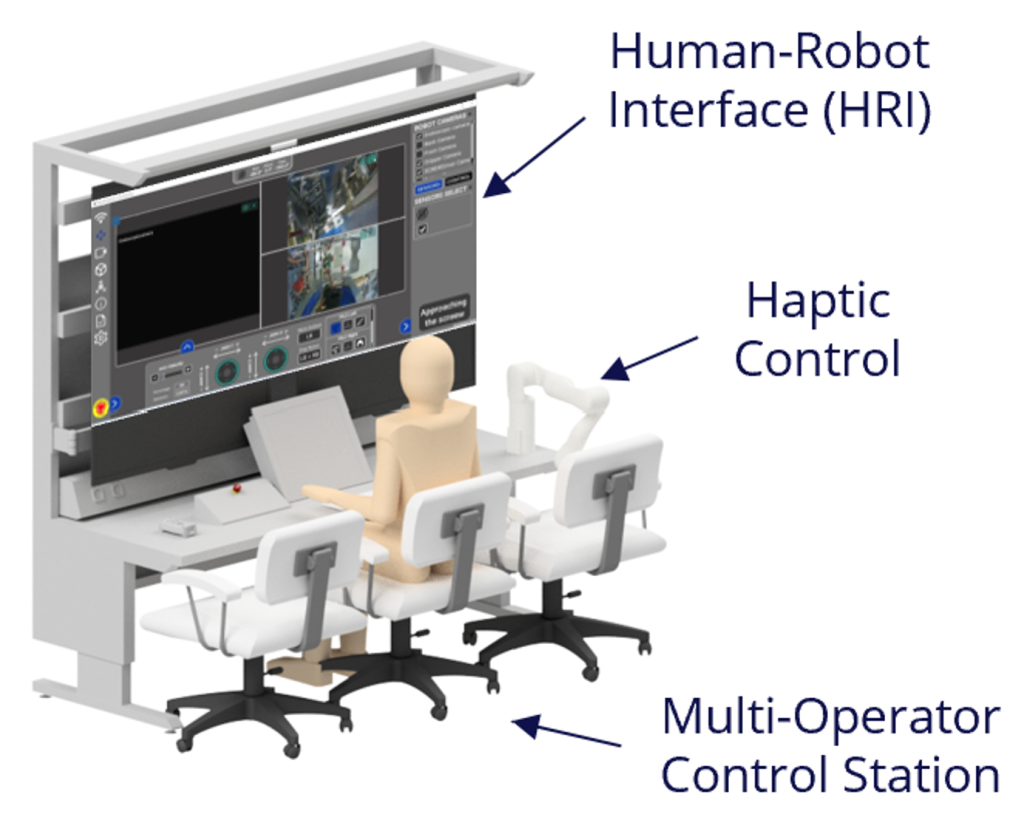
Sensors and interfaces: 2 lidars, 2 PTZ cameras, multi-operator control station, haptic feedback and VR operation areaValidation scope: Remote maintenance tasks, HSE and risk assessment, integration, tooling, procedures and standardised interfaces
RMIS installation procedure
The installation procedure for the RMIS was jointly planned, coordinated, and executed with EN-THE and EN-ACE. Despite the complexity of the operation, the installation was completed smoothly and successfully, as illustrated in the video below.
What will be validated in Building 355
The FCC Arc Cell mock-up provides a controlled environment to test both the robot and the robotics-ready infrastructure surrounding it. The aim is not only to demonstrate a moving robot, but to validate the full intervention chain: from access and operator interfaces to HSE controls, tooling, task execution and post-operation lessons learned.
Validation domains
| Domain | Examples of activities in the mock-up |
| Remote maintenance tasks | Object search and manipulation, accelerator alignment procedures, material transport, infrastructure maintenance and calibration sequences. |
| HSE and safety | Risk assessment, industrial robotic-cell safety assumptions, software limits, STO line, electronic sensors, physical stops, laser curtains/scanners, barriers and human detection. |
| Integration | Robot rails, power and data rails, barcode tape, communication reliability, cable routing, motor synchronisation and control-system integration. |
| Tooling and procedures | Gripper, screwdriver, drill, radiation-protection sensor, tool-exchanger concepts, robot-compatible screw heads and standardised intervention procedures. |
The mock-up will therefore function as a test bench for robotic-friendly infrastructure and operator interfaces. This supports the early-design objective: make accelerator equipment, services and access conditions compatible with safe, efficient and repeatable robotic interventions.
First use cases: from assisted teleoperation to supervised autonomy
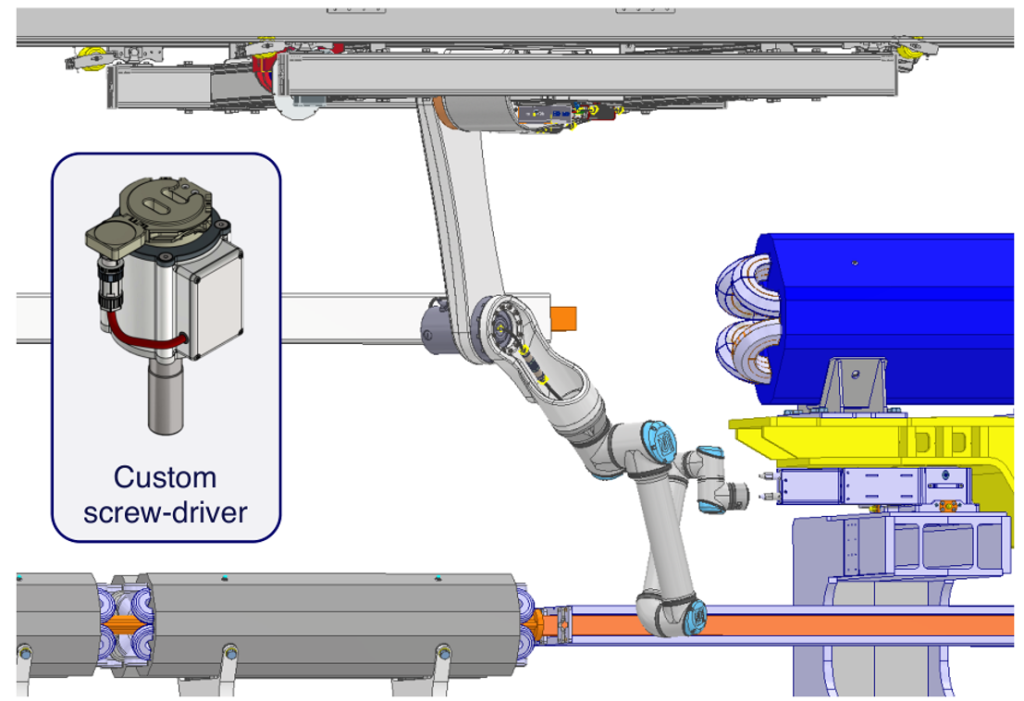
The first validation campaigns will focus on representative tasks that combine mechanical access, sensing, tooling, control and safety logic:
- Fully autonomous or supervised girder alignment, including requirement capture, environment adaptation, fiducial-marker tracking and verification and validation.
- Haptic guidance for insertion and extraction tasks, helping operators avoid contact with delicate equipment and improving operational confidence.
- Human detection and operator-awareness functions, including people recognition, tracking and alerts that can support HSE decision-making.
- Infrastructure maintenance, material transport and calibration procedures using the integrated hoist, end effector and tool magazine.
Expected impact for FCC design and operations
| AvailabilitySupport corrective, preventive and predictive maintenance concepts that can improve maintainability and reliability. | SafetyReduce human exposure to risky or physically demanding interventions and reinforce emergency and operational safety. | StandardisationTransform lessons learned into robotics-ready infrastructure, interfaces and a Code of Practice covering the full lifecycle. |
Next steps
- Complete installation checks and commissioning of the RMIS prototype in the Arc Cell mock-up.
- Run the first task-oriented validation campaigns, including HSE reviews and operator-interface tests.
- Capture evidence for robot-compatible design rules, tooling requirements and intervention procedures.
- Feed the results into FCC design studies and broader CERN robotics standardisation activities.
| Collaboration and contacts Prototype assembly and installation are carried out with contributions from EN-THE and EN-ACE. Use-case development includes collaboration with EN-MME and BE-GM for robotics-assisted alignment concepts. For robotic maintainability assessments and robotics-ready infrastructure validation, contact the BE-CEM-MRO robotics team. |