The world’s first high-temperature superconducting canted-cosine-theta sextupole comes to life
The demonstrator has been wound, cooled and powered-up, running beyond the current and temperature it was designed for
By Michael Koratzinos (PSI/CERN), Francesco Bardi (CERN), Ioannis Dimoulios (CERN) & Michal Duda (PSI)
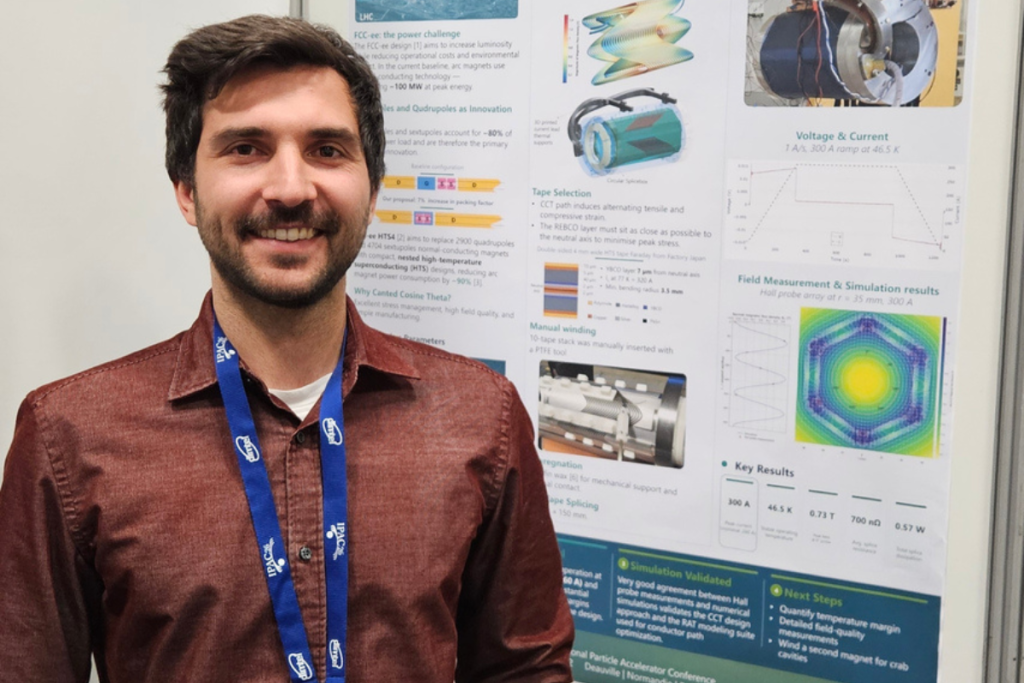
The world’s first high-temperature superconducting (HTS) canted-cosing-theta (CCT) sextupole now exists and has been successfully tested at cryogenic temperatures at the Paul Scherrer Institute (PSI) in Switzerland.
The magnet has been developed by the FCCee-HTS4 project, a CERN–PSI collaboration funded through the CHART consortium, with EPFL, ETH Zurich and the University of Geneva as partners. It was presented publicly for the first time at the 17th International Particle Accelerator Conference (IPAC’26) in Deauville, France, this May.
It has been designed with the purpose of being used in the proposed Future Circular Collider (FCC), CERN’s proposal for its next flagship accelerator. The FCC proposal contains two stages, the first is an electron-positron collider (FCC-ee), and the second would be a hadron-hadron collider (FCC-hh).
As current plans stand, the FCC-ee baseline uses normal-conducting arc magnets, and the sextupoles among them account for a substantial share of the machine’s power consumption through ohmic losses. HTS4 proposes to replace them with HTS magnets, which dissipate no resistive power and, operating well above the few Kelvin required by low-temperature superconductors, carry a far smaller refrigeration penalty. Because they shape their fields without iron, the magnets can also be nested, improving the packing factor and reducing the RF voltage the collider needs.
“As a key demonstrator for FCC-ee, this magnet represents an important step forward in HTS magnet technology,” said Francesco Bardi, an engineer at CERN involved in the HTS4 project.
“This achievement reflects the vision and perseverance of Michael Koratzinos, who led the project with determination and turned an ambitious idea into reality. It has been a privilege contributing to this milestone, which marked my first year and a half at CERN,” he added.