
CERN strengthens power-quality monitoring within the RF2.0 sustainability project
By Isabel Armundarain Arguello, Mario Parodi
As research infrastructures across Europe seek to reduce their environmental footprint while maintaining reliable operation, CERN is playing a key role in the Horizon Europe project RF2.0, Research Facility 2.0. The initiative aims to make particle accelerators and other energy-intensive facilities more sustainable, flexible and energy-efficient.
Running from 2024 to 2026, RF2.0 brings together six major European accelerator laboratories and four high-tech industrial partners to develop and validate technologies that can reduce the energy consumption and carbon footprint of large research infrastructures. The project addresses a growing challenge for the scientific community: ensuring that world-class research can continue while meeting Europe’s long-term sustainability objectives.
Particle accelerators are among the most complex scientific instruments ever built. Facilities such as CERN’s Large Hadron Collider require large amounts of electrical power and rely on a stable supply to operate efficiently. Even short disturbances on the electrical grid can affect sensitive accelerator equipment and, in some cases, lead to beam dumps or loss of availability.
Within RF2.0, CERN contributes its expertise in accelerator operation and electrical infrastructure, while serving as one of the project’s demonstration sites for new technologies. A particular focus is the improvement of power-quality monitoring and grid awareness across CERN’s electrical distribution network. In collaboration with Swiss technology company Zaphiro Technologies, CERN has installed and commissioned a network of 24 distribution-level Phasor Measurement Units, or D-PMUs, at strategic locations across its power system.
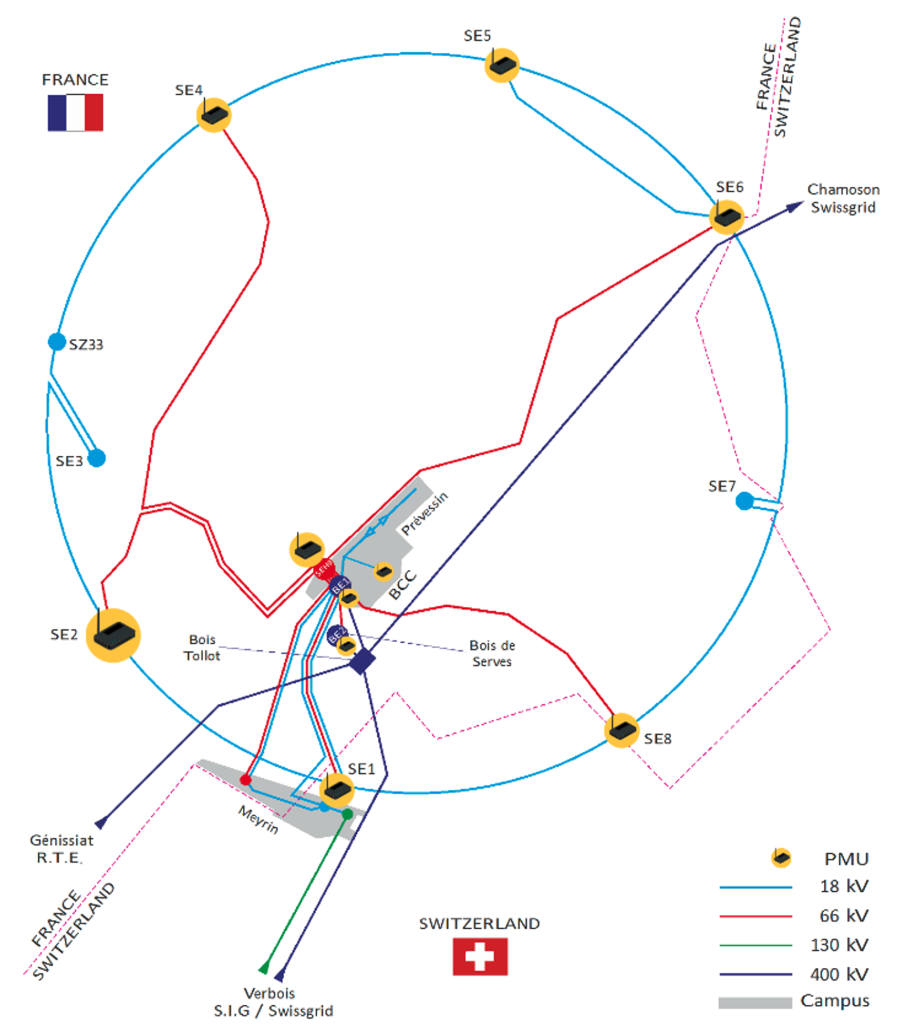
These devices provide high-resolution, time-synchronized measurements of voltage and current. Compared with conventional operational monitoring alone, they offer a more detailed picture of fast electrical events and how they propagate through the network. The PMUs are installed from the 400 kV interface with the transmission grid down to the 18 kV network supplying the LHC and associated infrastructure, allowing CERN teams to compare the same disturbance at different voltage levels and locations.
This represents a significant step forward in the digitalization of accelerator energy infrastructure. The objective is not to replace existing supervision systems, but to add a complementary monitoring layer that can support post-event analysis. For operators and equipment experts, the system can provide additional context after an electrical disturbance, helping to understand whether an event originated upstream or within CERN’s network, how it travelled through the grid, and which systems may have been affected.
The first recorded events have already demonstrated the value of this approach. By analyzing voltage dips and rapid voltage changes across different monitoring points, CERN teams can better understand the relationship between external grid disturbances, internal propagation and accelerator equipment behavior. This information is expected to support future discussions on mitigation strategies, equipment specifications and operational procedures.
The next step is to make the information easier to consult in the CERN operational environment. Work is ongoing to integrate relevant event information into CERN’s SCADA environment, so that operators can access PMU-based data when additional context is needed after a disturbance. The measurements collected through RF2.0 will also feed modelling activities and the development of a data-driven digital twin of CERN’s electrical infrastructure in collaboration with the Karlsruhe Institute of Technology.
The knowledge generated through RF2.0 will also support CERN’s long-term vision for future accelerator facilities, including studies linked to the Future Circular Collider. As energy efficiency, reliability and environmental sustainability become increasingly important design criteria, high-resolution monitoring can help define how future accelerator power systems should be designed and operated.The RF2.0 project has received funding from the European Union’s Horizon Europe research and innovation programme under grant agreement No. 101131850 and from the Swiss State Secretariat for Education, Research and Innovation.