
Crystal shadowing to reduce beam losses
A new system made of precisely aligned thin, bent crystal arrays will greatly improve particle beams sent to fixed-target experiments in CERN’s North Area, while also protecting sensitive equipment
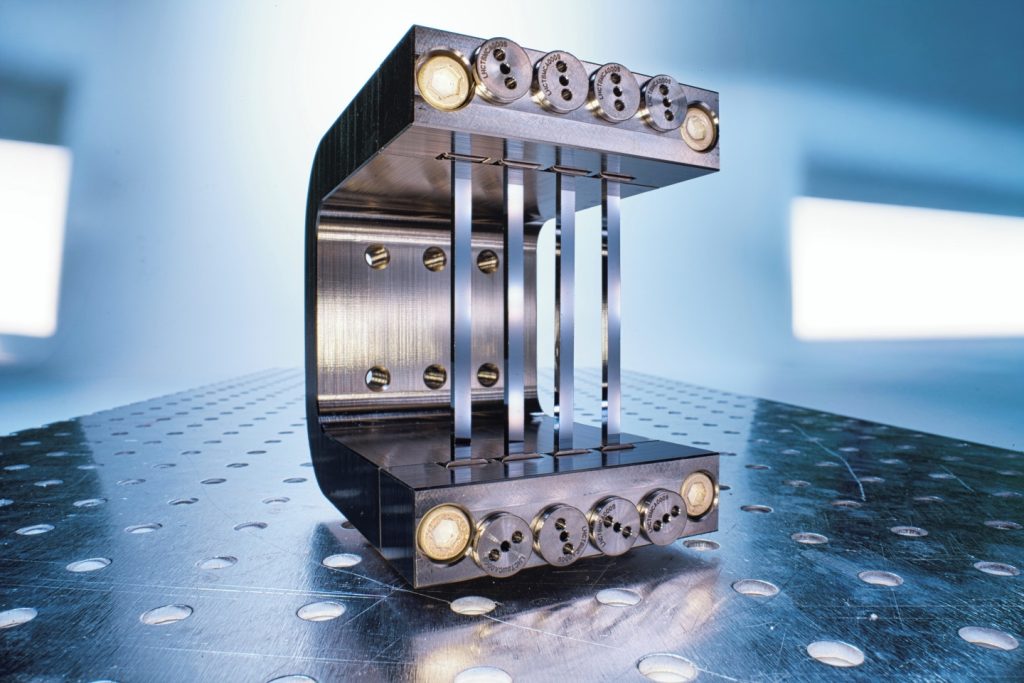
“If you place a large rock in a flowing stream, you can shelter objects located just downstream. It’s much the same with crystals and a beam of particles,” explains Francesco Velotti, applied physicist in the Accelerator Systems (SY) Department. This “crystal shadowing” technique has been successfully used in the Super Proton Synchrotron (SPS) since 2021 and is now entering a new phase, with the recent installation of a refined system made of three crystals ready for testing in the SPS.
As the last injector for the Large Hadron Collider (LHC), the SPS also supplies proton beams for the North Areafixed-target experiments. Proton beams are extracted from the SPS using a process known as slow extraction. As its name suggests, slow extraction delivers the beam over long time intervals, producing extended particle pulses. This allows the beam to be spread out in space and time, a key requirement for fixed-target experiments that rely on stable and uniform particle fluxes.
But slow extraction comes with a significant challenge. Compared with fast extraction, it leads to higher beam losses, which in turn result in increased damage to accelerator components. One of the most exposed elements is the electrostatic septum, a critical device that shaves off the circulating beam from the extracted beam. Beam losses in this region are particularly problematic, as they limit accessibility for maintenance and place constraints on long-term operation.
To address this issue, a team of experts from the SY Department (SY-ABT, SY-BI and SY-STI), with contributions from the Beams (BE) Department (BE-CEM), developed and installed a crystal-based system to avoid beam losses. When inserted into the beam, the bent silicon crystals act as a protective shield for the septum through a so-called shadowing effect. The position of the crystals can be remotely adjusted according to beam conditions. This development was carried out in the framework of the DECRYCE project (DEvelopment of CRYstals for Collimation and beam Extraction), a project created in 2022 to address the full research and development cycle for crystal systems at CERN, from design and engineering of crystal benders to silicon strips, assembly of crystal systems and experimental validation.