
5-minute race with 450 °C titanium: shrink fitting trial of CFC plates for HiLumi LHC beam dumps
By Nicola Solieri (CERN)
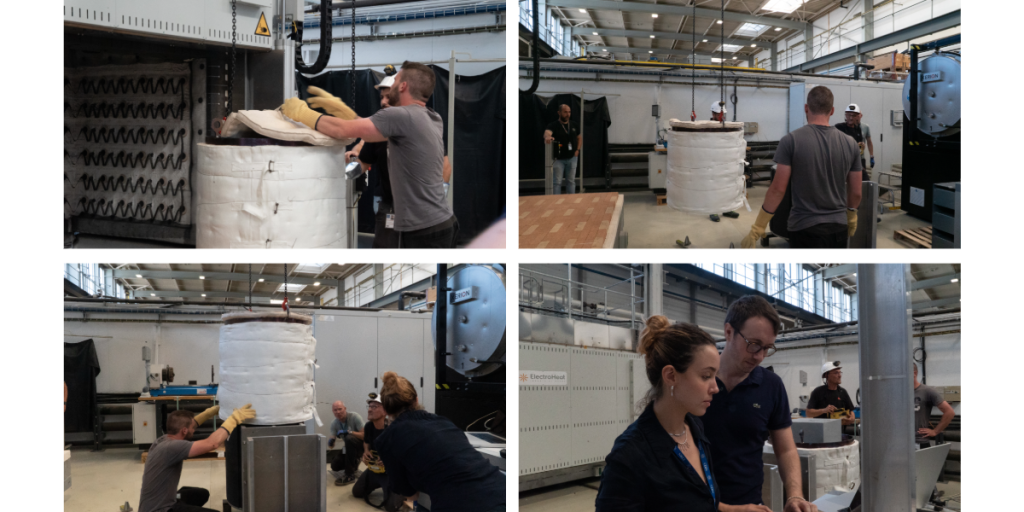
The successful shrink-fitting trial of the carbon-fibre-reinforced carbon (CFC) plates into the titanium vessel marked the final crucial milestone in the validation of the assembly process for the High-Luminosity (HiLumi) LHC beam dumps. This shrink fitting process will be a crucial step in the assembly of the beam dumps, and involves many challenges, presented by the high temperatures needed to expand the titanium tube to allow it to fit over the stack of CFC plates, the small time window to manoeuvre the hot tube over the plates, and the precision required during the lowering.
An interference fit is used to fit the parts together: at room temperature the CFC plates are larger than their housing in the vessel, so the titanium tube is heated to 450 °C and fitted over the plates. As it returns to room temperature, the two parts press tightly together, creating a strong mechanical hold and good thermal contact.
At 450 °C, a clearance of only 1 mm is created between components measuring 700 mm in diameter, and the fitting must be completed before the titanium cools and is unable to fit over the plates completely and without damage…